Friday, January 6, 2012

Filling the Vacant Sees

In the USA, only the dioceses of Salina and Baker have been vacant longer than any other Latin Rite diocese, which means now the pressure is on to fill them before the Holy See fills other vacancies . . . such as (in chronological order):

Currently vacant:

St. Francis de Sales,
Patron of the Diocese of Baker,
pray for us!

·         Salina (KS)
·         Baker (OR)
·         Pensacola-Tallahassee (FL)
·         Steubenville (OH)
·         Tyler (TX)
·         Denver (CO) - archdiocese
·         Baltimore (MD) - archdiocese
·         Indianapolis (IN) - archdiocese
·         El Paso (TX)

...and soon-to-become-vacant:

·         Lincoln (NE)
·         Rockford (IL)
·         Buffalo (NY)
·         San Francisco (CA) - archdiocese
·         Erie (PA)
·         Las Cruces (NM)
·         Orange (CA)
·         Chicago (IL) - archdiocese
·         Portland (OR) - archdiocese
·         San Angelo (TX)
·         Grand Rapids (MI)
·         Saint Cloud (MN)
·         Rochester (NY)
·         Hartford (CT) - archdiocese
·         Jackson (MS)
·         Springfield (MA)

Looking at this situation with mere human intellect, this is what comes to mind: Frankly, if I were a candidate for the order of Bishop, and I knew that all these (arch)dioceses were vacant or shortly becoming vacant, I'd hold out for a "better offer" than Baker (with its multi-million dollar debt, only two seminarians, and clergy and faithful in turmoil).

Of course, I don’t really know all of the problems that might abound in some of the other dioceses…

 
EXILE TO FORT SEDGEWICK
On the other hand, I am becoming more and more aware of some of the “politics” surrounding the appointment of a bishop for the Diocese of Baker. I don’t think it’s any secret that the bishops of the neighboring dioceses will be lobbying for a Baker bishop who is somewhere to the left (probably way to the left) of our former right-of-center bishop, Robert F. Vasa. It’s pretty easy to find evidence of dissent in the Archdiocese of Portland – everything from liturgical abuses to squelching of the EF Mass to support of the homosexual political agenda to lack of support for pro-life causes; surely this speaks to the outlook and priorities of the Archbishop, who has just as surely been asked for his recommendations for a bishop for the Diocese of Baker. Looking eastward to Idaho, I see a bishop who has shown, at the very least, a lack of support for the Extraordinary Form of the Mass; his recommendations, too, have surely been solicited by Rome. And of course, our current Apostolic Administrator was the Bishop of the Diocese of Spokane until 2010, and there’s no reason to doubt he would recommend a bishop similar in outlook to his own.
On the other side of the fence, many among the more traditional-minded laity and clergy have also made their desires and recommendations known to the Apostolic Nuncio and to the Vatican regarding the kind of bishop needed here – a holy man who will firmly uphold ALL of the teachings of the Church, who will be a good shepherd to the faithful, and who will be a caring father to his priests.

Ultimately, though, we must trust the Holy Spirit; we must abandon ourselves to Divine Providence.  Our own human judgment is clouded by our misperceptions, our stubborn preconceptions, our petty jealousies, and our selfish and self-centered desires.

Truly, we should all pray that God’s will be done.

Here is the collect from the votive Mass for the election of a bishop. May we have a holy shepherd in the Diocese of Baker soon.

Deus, qui pastor aeternus,
gregem tuum assidua custodia gubernas,
eum immensa tua pietate
concedas Ecclesiae (Bakeriensis) pastorem,
qui tibi sanctitate placeat,
et vigili nobis sollicitudine prosit. Per Dominum.

Lord God, you are our eternal shepherd and guide.
In your mercy grant the Church (of Baker)
a shepherd who will walk in your ways
and whose watchful care will bring us your blessing.
We ask this through Our Lord…


See also: "A Different Breed of Bishops" on this blog (Jan. 9 post).


Wednesday, January 4, 2012

Who Cares About Canon Law?

Once upon a time, I had great faith in the judicial system of our country. I watched Perry Mason when I was a kid, after all, and he was always able to prove the bad guys wrong in court. The underdog always won, and justice prevailed.
I actually had that naïve faith well into my adult years. Then I became involved in defending the rights of a very mildly retarded woman to raise her own children. Because this woman had no money to speak of, and because I didn’t have much more, we had to find an attorney to take the case pro bono…which we did. Well, sort of.  I paid a small sum of money up front, and then became the assistant to the attorney in everything from serving subpoenas to collecting evidence to writing letters to composing questions to ask during the hearings.
The turning point in my view of the judicial system came when I was called as a witness in the case, and the prosecuting attorney began to question me. All of a sudden it became very clear to me that the questions he was asking were not honest questions aimed at uncovering the truth and seeking to do what was best for this family that was under scrutiny; they were dishonest questions with a not-so-hidden agenda of simply making me look bad, and winning the case for the County. And to top it all off, the judge appeared to be asleep through most of the proceedings (there was no jury in this case).
I’ve had a rather jaundiced view of the judicial system since then.
A similar thing is happening with my view of Canon Law. I think Canon Law is great stuff. If I were decades younger, I’d consider pursuing a degree in it. But the more I see it put into practice – or not – the more jaundiced my view is becoming.
As a case in point, let’s take Michael Voris, RealCatholicTV, and the Archdiocese of Detroit. And let’s throw Dr. Ed Peters’ analysis of that situation into the mix, too. Now let it be known that I have the utmost respect for Dr. Peters, and I have no argument with his canonical assessment of the Voris/RCTV/AoD situation. I have no argument with the fact that, as he says, it is a question of Canon Law on the use of the name “Catholic”, and not a popular vote as to the real Catholicity of Voris and RCTV. Canon Law has some clear things to say about the whole situation.
Except that the truth probably is that it’s not about Canon Law at all. It’s about saving face, or squelching orthodox Catholic teaching, or maybe punishing a guy who probably ticks off bishops on at least a weekly basis. In other words, Canon Law is not being used for honest ends. It’s being used to make Voris and RCTV look bad.
All of the above is my humble opinion, of course.
I have other reasons for starting to turn a little sour in my view of Canon Law. There’s the ongoing battle in my diocese (Diocese of Baker) over the right of the faithful to have the extraordinary form of the Mass celebrated in the manner to which we were becoming accustomed, prior to the reign of Apostolic Administrator Bishop William S. Skylstad. I have written personal letters to the powers-that-be, and the Society of St. Gregory the Great (the sponsor of a monthly EF Mass in Bend, OR) has written letters to the same offices. And the best response we’ve been able to get is this:
“Since the Diocese is still vacant, the right course of action is to wait patiently for the appointment of a new Bishop.”
This is directly from the Pontifical Commission Ecclesia Dei. Frankly, it’s not acceptable. It’s a wimpy response; it’s a “pass the buck” response – or perhaps more accurately, a “drop the ball” response.
A big part of the problem is that Bishop Skylstad does not seem to want to go away, and he seems to want to re-make the Diocese of Baker in his own image. In addition, I have it on good authority that a lot of political action is taking place behind the scenes which is making Rome reluctant to act in terms of appointing a new bishop. Our diocese is in crisis mode, and Rome knows it; they want the problems fixed before they appoint a bishop…but that’s not likely to happen, since the current administrator is the problem. And who would want to accept the appointment at this point?! It would have to be a very brave man. (I could go further with the implications of that statement, but I think I will just leave it at that.)

I’ve documented all kinds of ways Bishop Skylstad has violated Canon Law (here, here, and here), and he’s committed more violations than I’ve revealed on this blog. The point is that he has set himself above Canon Law, and no one seems to want to hold him accountable for his transgressions. And he is not the only bishop to act in this way.  I see it currently in various other dioceses, and I see it in the public record of the last several decades as I research the controversies different bishops have created.
And so, I’m about at the same point with Canon Law and the Church’s judicial system as I am with the civil judicial system.  It’s all well and good on paper. But in practice, the best of human intellect’s attempt to regulate the worst of human nature falls flat on its face.  Score one for fallen human nature…for the moment.

The Lighter Side of Liturgical Abuse

Okay, so there's NOT a lighter side of liturgical abuse...not really.

Still, sometimes we must look for a little comic relief.

So let's have a little lesson in:


No, this is NOT meant to be a "how to". It's about recognizing things that are WRONG!

Now generally speaking, it would seem that all Catholics really should be able to recognize that things like this occuring at Mass are just plain wrong.


But...there's a bishop...so it MUST be okay, right?
Wrong. This is called "giving scandal".

 
Everyone should know this is wrong. So why is it taking place at
a Religious Ed Conference? What are they teaching our children?!


Now, something like this...kinda low key... Maybe some people don't understand that it's an abuse. Seriously though...you should know!


And everyone, including that priest, should be able to say "Something is just not right here..."


Many would look at this scene and think, "But...our parish looks like that every Sunday!"
It's still wrong. We can talk about it later if you want.


Just to prove that I really do have a sense of humor, I found this next picture hilarious. If I'd been a cradle Catholic, it probably would've been my story.

PS: if you don't know what a corporal is, you may be visiting this blog by mistake!
But you are welcome to stay and learn!


This next one is not for the squeamish! Some people think of me as the person holding the gun. But the truth is, we would probably have better luck extinguishing liturgical abuse by this method than by trying to explain why a liturgical abuse is an abuse, and why it matters.


And to those who ask me, "Do you REALLY think the Lord cares about all those silly details?"
Yes. I do. In fact, I'm sure of it.


And just so that we may end this post on a very positive note which I think combines a great sense of reverence with an irresistible "awwww" factor:


New Year's Resolutions

Michael Voris has some good suggestions here:


And yes, as he notes, all of them will make you wildly unpopular...

Another hero, Fr. Michael Rodriguez of the Diocese of El Paso, recently sent an email message to the faithful of his diocese; I think his words can speak to those of us in other dioceses as well, as we face the challenges of a secular society and lukewarm Catholicism. He says in part:

"Now is not the time to be indifferent, complacent, or tired. Now is the time to really STEP IT UP! Remember, we are soldiers for Jesus Christ, and we must fight for His Cross, His Kingship, and the Catholic religion which He established by shedding His Precious Blood."

Here's another resolution that I adopted a few months ago:


I'm not sure if he's saying "Oh no" yet,
but I'm pretty sure he hears my feet hit the floor.

St. Michael the Archangel, pray for us!


Monday, January 2, 2012

Put Your Money Where Your Mass Is

Despite my hopeful post on “Paving the Way for the EF Mass”, I must admit that priests, in my experience, don’t want to change “what we’ve always done” when the people seem to be entrenched in it. Pastors are afraid people will become offended and leave the Church. Wait…check that: they are afraid people’s money will leave the church.
During the time I worked as a parish secretary, two priests told me they did not want to know whether or how much money individuals were donating each week – they just wanted to know the collection total. Even though they did not know who was giving what, they had a vague sense that “more people” equals “more money”; any hint that people were angry about changes in the liturgy left them anxiously trying to balance liturgical correctness against political correctness.  
While it makes logical sense that collections will be larger when the congregation is larger, this is not always true. Sometimes there are a few families who make large donations that carry the parish financially, with many others making much smaller donations to round out the “big hitters”.  Often, those big donors do not make a show of their contributions - nor do they make threats about withholding their funds. I know that in two parishes I attended, a family who was donating large sums stopped doing so…because they were offended by the liturgical practices of the parish. They voiced their concerns without mentioning money; their concerns were not addressed, and their money found another home.
One priest in our diocese told me that, in his parish, a few people objected to some changes he was making, and they did threaten to withhold their contributions…but then he discovered that the amount they gave was almost inconsequential in the large budget of the parish. And another priest friend has told me that in his parish, the largest share of the financial contributions come from the Mass that has the smallest number of attendees.

I have heard priests explicitly mention that they do not want to offend parishioners because the collections will decline. However, even though a parishioner may give generously, if he (or she) consistently asks for liturgical abuses to be corrected, or for implementation of discarded rubrics, he is considered little more than a nuisance. No one is worried about offending him; no one is worried that he will stop attending Mass. In fact, they hope the "trouble-maker" will move away.
The truth is, any person who makes valid, well-documented arguments against liturgical abuses that are currently accepted and welcomed in a parish is not viewed as one of “the people”, and no one really cares about his money or his other contributions to parish life.
Interestingly, despite this preoccupation with Mass attendance, there seems to be little concern on the part of priests that people who are offended at liturgical abuses – the more traditional parishioners, the ones who want Gregorian chant and Latin, and no guitars or trumpets...the black sheep – have stopped attending Mass. One couple I know, fed up with the abuses at their parish, began traveling almost 2 hours each way most Sundays in order to attend Mass at an SSPX chapel. They did not consider themselves disloyal to the Holy Father; they just wanted a liturgy that followed the rubrics. But if they couldn’t make the two-hour trip due to weather or any other concerns, they simply did not attend Mass. Although that should have concerned their parish priest, the pastor never spoke to them about it .Contrary to the Gospel account of the lost sheep, the shepherd stayed with the 99 who were "comfortable" with "their" liturgy, and let that one "complainer" go on his way.
Sometimes, there’s a parish priest who does want to make changes in the direction of liturgical correctness. He is immediately faced with protests and criticism from the “other side”, and sometimes that includes letters of protest written to the bishop. In my diocese, the priests who have struggled to lead their parishes toward a more orthodox celebration of the liturgy have received little or no support from the bishop. This is just plain wrong. And so, most priests seem not to make the attempt.
And that, my friends, is why I maintain that true liturgical renewal – righting the wrongs that have crept into the liturgy these past 40-50 years – will only be accomplished by firm leadership from our bishops. A priest can only do so much at his parish; if the bishop instead sympathizes with the “happy clappy crowd”, the priest will ultimately be silenced. But if the bishop and his priests are on the same page – an orthodox, liturgically-correct page that helps the people grow in holiness – then much can be accomplished.
Let the liberals and modernists have their tantrums and make their threats, and let them even leave the Church if they do not accept Her teachings. It is no great charity to bend the rules to keep people coming to Mass if they truly do not believe what the Church teaches; in fact, it only encourages them to receive Holy Communion unworthily.

Let them go, and let them take their money with them. Let God deal with the financial fall-out. He will provide. It’s what He does.

Paving the Way for the EF Mass (TLM)

Okay, enough messing around with trying to satirize the shenanigans that go on as some priests and bishops attempt to subvert the legitimate spiritual desires of the faithful to have free and ready access to the extraordinary form of the Mass.


[See also: The Novus Ordo Should Be Outgrown]
What can we do that is constructive and positive?  
I’m presenting here an outline of a program that I think could work in many parishes – provided, of course, that a willing pastor is available. There are two main goals. The first is to bring the parish to a more reverent celebration of the Novus Ordo through the re-introduction of chant, the use of the Latin ordinary, and the use of the Mass propers.
The second goal is to pave the way for the introduction and promotion of the EF Mass as a rite that is just as valid (if not more so…but we won’t go there right now) as the NO. The EF Mass deserves to have a prominent place in the Mass schedule – rather than being relegated to a time slot that is unconventional and inconvenient for most. And I believe that if the pastor of a parish wants to lead his flock into an understanding of why this is so, he can do it. It may take some time and effort, but it can be done.
In my parish, the pastor has shown great willingness to provide the EF Mass for us – putting in the time and effort to learn to celebrate it, and offering it every Sunday for almost a year, despite his very demanding schedule. For various reasons, though, we do not see our little group growing. I think it could grow, though, if the rest of the parishioners were appropriately catechized about the EF Mass, and if the liturgical celebrations of the parish as a whole were moved toward greater reverence and a stronger reflection of our Catholic identity.
This outline, created for the particular circumstances of my parish, can be adapted for any set of circumstances and Mass schedules. I haven’t included anything about the Spanish Masses said in the parish, but it would be a good goal, I think, to also introduce the suggested changes into the Masses said in languages other than English (or Latin).
Also, my parish had a liberal priest for over 15 years, and the people still suffer from their exposure to the happy clappy liturgical abuses he allowed (encouraged?). A parish with less liberal baggage might move more quickly through the suggested changes; one with more baggage will pose more of a challenge. The pastor will have to exercise his own discernment as to how quickly changes can be made.
Here’s the program:
1.      Start using a Latin chant ordinary at least once per month at Sunday Mass (i.e., Kyrie, Gloria, Sanctus, Agnus Dei), and introduce a sung Credo.

Why:
a.      To help the choir learn the Latin ordinary
b.      To accustom the people to the Latin ordinary
c.       To prepare the people for the extraordinary form of the Mass
d.      To accustom the people to singing the Credo

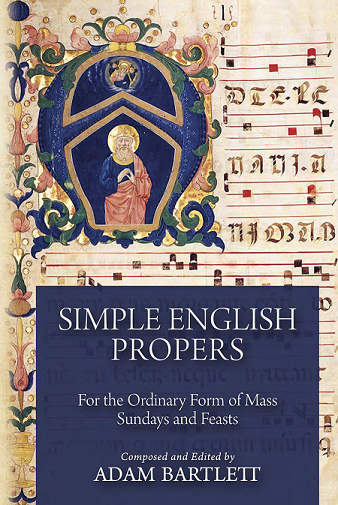
2.     Use the Simple English Propers instead of the usual songs sung at Mass

Why:
a.      These are more in line with the new translation
b.      To foster a return to a more liturgically correct use of music in the Mass (that is, use of the proper chants designated by the Church as appropriate for each week’s Sunday liturgy)
c.       To foster our Catholic identity by preventing use of questionable hymns and musical styles


3.     Gradually integrate the above into the way the Mass is celebrated currently:

Method:
a.      Sing an “entrance hymn”, but before the priest begins Mass, have the choir (or cantor) sing the introit from the Simple English Propers.
b.      Instead of a hymn for Communion, use the proper of the day. Start with singing the Simple English Proper, with verses. At some point, add a Latin hymn. Progress to the Latin chant proper.
c.       Introduce these changes first at the 7am Sunday Mass when a cantor is available; also introduce Latin propers at 7am Sunday Mass occasionally. [This suggestion is specific to my parish; this is a sparsely attended Mass and the people may be more amenable to the Latin propers.]

4.     Slowly introduce ad orientem worship.

Purpose: To take the focus off of the priest as an individual, and to re-educate the people that Mass is totally focused on Our Lord, with all facing God as the priest offers our prayers.

Method:  Begin at Saturday evening Mass, then 7am Mass; at each, introduce ad orientem at one Mass per month, then every two weeks, then every week.  Progress to one Sunday/month at 9:30 Mass. Catechesis may be by way of bulletin inserts and explanation from pulpit. Also, a workshop could be held to explain it and deal with fall-out.


This actually looks a little odd to me...does it to you?
 But it might be a palatable transition for those
who don't yet understand  ad orientem worship.
5.     Gradually, and without making a show of it, phase out female altar servers and recruit boys. Use cassock and surplice once all servers are male.

Why: To promote vocations, which are sadly lacking in our diocese! Also, the cassock and surplice are head-and-shoulders above the standard hooded alb (which makes the kids look like the seven dwarves) in terms of fostering reverence and respect for the liturgy.

6.     Select, recruit, and train boys to serve at EF Mass.

Why: to be celebrated well, the EF Mass needs servers. They must be male. Training the younger crowd in the EF Mass is another way to foster vocations, as well as fostering an increased reverence and appreciation for the Real Presence of Jesus in the Eucharist.

See the great article that goes with this photo!


7.     Introduce bulletin “blurbs” about the EF Mass, explaining that it will become a regular part of the parish’s worship, even beyond the EF Masses currently scheduled at the less desirable times (e.g., Sundays at 1pm).

8.    After a suitable period of introducing these changes, announce that the EF Mass will be celebrated on at 9:30am one Sunday per month; on that Sunday, the Novus Ordo  Mass will be available at 1pm for those who prefer it. (Can you hear the shrieks even as we mention the very thought?!)

Really, I think this could work…but only if the priest is excited about it. He will have to be strong, because he will face unrest and discontent from parishioners, who will complain to the bishop.  And if the bishop errs on the side of political correctness, the priest will be persecuted. Stand by him! Encourage him! Pray for him!

Pray for all the clergy.


Sunday, January 1, 2012

How to Undermine the TLM in Your Parish

My post “7 Reasons Why You Should NOT Go to the TLM” was aimed primarily at the lay faithful. (The laity must be warned about this monster lurking in the closet!)
This post is aimed at pastors. Since the TLM will lead to all sorts of unseen and unwanted side effects in parishioners, pastors are advised to take the following steps to deter any efforts to get a TLM established, or to undermine one that is already celebrated with any sort of regularity.
N.B.: Some pastors inadvertently engage in some of these hindrances. I hope such good shepherds will see these notes as a warning as to what to avoid if they want the TLM to flourish in their parishes.

That said, here are my suggestions for undermining the TLM:
1.       Arrange the schedule so that the time and date of the next TLM is almost impossible to ascertain more than one hour in advance. For instance, the TLM could be scheduled at any of these times:

a.      At 3:47 pm on alternate Sundays unless there is a youth Mass that week. In that case, the TLM time and location will be announced at 3pm, at the beginning of the Youth Mass..

b.      At noon on the first and third Sundays of the month, unless there’s a Spanish Mass at 11, in which case the TLM will be moved to 1 pm; or unless the priest has to celebrate Mass at one of the mission churches, in which case the TLM will be moved to 3pm; or unless there is a choir practice for the children’s Mass, in which case the TLM will be cancelled. Announce the particular circumstances of that week’s TLM at the 9:30 am Mass, during the announcements...when no TLM types are likely to hear it.

c.       Every fifth Sunday when there is a full moon; no need to announce a time and location, because there will almost never be a fifth Sunday with a full moon.

2.      Do not allow or encourage any Latin in the main Masses of the parish, and allow and encourage those parishioners who are willing to bad-mouth it and talk about how Latin is a step backwards in the progress of the Church.

3.      If you are the pastor, and it is your associate who says the TLM, make sure he experiences last-minute schedule changes that require, sadly, that the TLM be cancelled that week. A motivated pastor can make sure this happens every week.

4.      Require the TLM crowd to conspicuously attend the Novus Ordo Masses in your parish, in order to prove that they are giving the NO a chance, and are willing to be a part of the community. Do not require the NO crowd to attend any TLMs, though.

5.      After a few months of the irregular scheduling described in #1, and the additional effects of #2-4, allow a TLM to actually take place. Sadly note the dwindling (or perhaps even non-existent) attendance, and announce that, given the lack of interest, the TLM will no longer be offered.

6.      If you don’t know how to say the TLM, use that as an excuse, and say that you do not have the time or ability to learn Latin. Do not let any parishioners know the extreme measures you have taken to learn and offer the Mass in Spanish (or Vietnamese, or any other language), however.

7.      If all else fails, say that the bishop will not allow you to offer the TLM due to complaints received by those who don’t want it in “their” parish. And always be "so sorry" about all of this.

There you have it: seven easy steps to squelching the TLM in your parish! These are bound to do the trick, and you might even just “lose” those pesky veil-wearing, communion-kneeling, tongue-receiving, traditional-minded trouble-makers to another parish in the process. Make sure you send the above list on to the next pastor that has to deal with them.

And...if you're one of the trouble-makes, take your own list to the next parish.