Modernistic/personalistic language can sound so good! For
instance, here is a definition of chastity from the CCC (my emphases
throughout):
 2337 Chastity means
the successful integration of sexuality within the person and thus the inner unity of man in his bodily and
spiritual being. Sexuality, in which man’s belonging to the bodily and
biological world is expressed, becomes personal
and truly human when it is
integrated into the relationship of one person to another, in the complete and
lifelong mutual gift of a man and a
woman.
2337 Chastity means
the successful integration of sexuality within the person and thus the inner unity of man in his bodily and
spiritual being. Sexuality, in which man’s belonging to the bodily and
biological world is expressed, becomes personal
and truly human when it is
integrated into the relationship of one person to another, in the complete and
lifelong mutual gift of a man and a
woman.
The virtue of chastity therefore
involves the integrity of the person
and the integrality of the gift.
Who would want to argue that “sexuality” is not meant to be “integrated” into the
relationship of one person to another, a “lifelong mutual gift”? But those
words are very nebulous. Isn’t it much more to the point to say, as the Catholic Encyclopedia
does, that:
Chastity
is the virtue which excludes or moderates the indulgence of the sexual
appetite.
Or as My
Catholic Faith says:
Chastity is that moral virtue which
disposes us to be pure in soul and body.
That lays it on the line. We are not left wondering what exactly the “integrality of the gift”
means, nor are we led to focus on our “inner unity”. Instead, we are led to
consider this virtue in the way it is meant to bring us closer to God: by being
“pure in soul and body”.
The CCC of
course has more to say, and again, these are fine-sounding words:
 2338 The chaste person
maintains the integrity of the
powers of life and love placed in him. This integrity ensures the unity of the person; it is opposed to
any behavior that would impair it.
2338 The chaste person
maintains the integrity of the
powers of life and love placed in him. This integrity ensures the unity of the person; it is opposed to
any behavior that would impair it.
Not bad. Still, the modernist
focus on the “person”, while it has value as a way of framing the definition of
the virtue, can lead down the road to moral relativism via the “it’s all about
me” path.
Compare that paragraph from the
CCC to this one from My Catholic Faith:
…For the unmarried, chastity forbids
indulgence of the sexual appetite; for the married, it regulates the use
of that appetite in accordance with the dictates of right reason…
There’s a clear statement about
something that is forbidden in a particular situation, and regulated in another.
Of course, this paragraph assumes we will understand the “dictates of right
reason”, and perhaps that’s harder for our modern minds to grasp than it is to
ponder “inner unity”! The “modern world” isn’t too interested in “reason”, it
seems.
Here’s a section that’s a little more concrete (italics
in original):
2339 Chastity includes
an apprenticeship in self-mastery which is a training in human freedom.
The alternative is clear: either man
governs his passions and finds peace, or he lets himself be dominated by them
and becomes unhappy.126
That footnote references Sirach 1:22, so the statement has a solid biblical
foundation; maybe that’s why it seems pretty straightforward! But then the
paragraph continues with a touch of personalism:
“Man’s dignity therefore requires him
to act out of conscious and free choice, as moved and drawn in a personal way from within, and not by blind impulses in himself or by
mere external constraint…”127
This is a direct quote from Gaudium et Spes. It sounds good…sort of…but look at it carefully. It
says that we must be “moved and drawn in a personal way from within”. But
immediately, we are warned that this guidance should not be “by blind impulses” in ourselves. Well, which is it? How do
we discern being “drawn from within”, versus a “blind impulse”? I would argue,
following scripture, that our inner self (our “heart”) often misleads us
through such a powerful deception that we think
we are following God when in fact we are following our own blind impulses: “More
tortuous than anything is the human heart, beyond remedy; who can understand
it?” (Jeremiah 17:9)
These are just a few examples of how the vocabularies of
modernism and personalism permeate the CCC.
Similar examples can be found in the 1983 Code of Canon Law, and in Humanae Vitae, but that would make for a
much longer post than I’m willing to tackle right now.
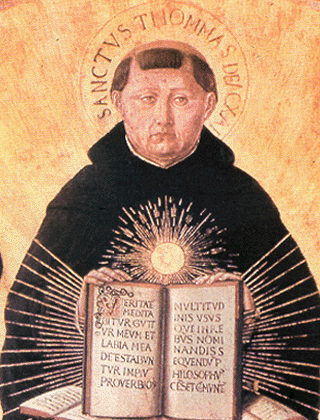 The point is that the words we use have an impact on our
understanding of the concepts. Personalist and modernist philosophy frame the
concepts in words that lead us into an understanding of marriage and chastity
that is quite a bit different than that taught by St. Augustine and St. Thomas
Aquinas, which formed the foundation for the papal encyclicals and letters on
marriage of Popes Pius XI and XII.
The point is that the words we use have an impact on our
understanding of the concepts. Personalist and modernist philosophy frame the
concepts in words that lead us into an understanding of marriage and chastity
that is quite a bit different than that taught by St. Augustine and St. Thomas
Aquinas, which formed the foundation for the papal encyclicals and letters on
marriage of Popes Pius XI and XII.
To understand how that happened, let’s take a quick look “behind
the scenes” peek at Vatican II and Humanae
Vitae.
The Second Vatican Council was, in large part, focused on
addressing the concerns of the Church “in the modern world”. That’s why we have
a “Pastoral Constitution on the Church in the Modern World” (Gaudium et Spes, or GS) emanating from the Council. In this important document, we find
language that reflects a modernist philosophy, and which remains problematic in
some cases. The modernist vocabulary is generally less precise and more
“feel-good” than the words and phrases that address similar concerns in
documents that preceded Vatican II. For pastors, the imprecise vocabulary makes
it easy to bend an interpretation of it to fit one’s personal opinion, or to
hedge one’s bets when offering guidance to the faithful. For the faithful
reading the documents, the same thing is true; for instance, even if a priest
tells a couple that NFP is allowed for serious reasons only, the couple can
point to GS and HV and say, “but, see, it’s up to us to decide what’s ‘serious’.”
The modernistic and personalistic language of Gaudium et Spes permeates Humanae Vitae, and from there the
concepts and vocabulary spread to Canon Law and the new CCC. How did this all happen? Well, in a nutshell, according to Anne Roche Muggeridge, in her 1986
book, The
Desolate City:
Then
in April 1964, [theologian] Bernard Haring addressed the commission and
persuaded it to drop the whole argument
from the natural law upon which the Church’s teaching on contraception was
largely based…From that time, the emphasis in the commission’s discussion of
marriage shifted from the objective,
social, and eternal dimensions of marriage to the subjective, personal, and temporal. (p.79)
Similarly, in Humanae Vitae:
Heroic, Deficient, or Both?, John Galvin notes that while HV comes to the right conclusion
regarding the immorality of artificial contraception, it neglects Tradition,
Scripture, and the Magisterium in coming to that conclusion. The omission opened
the gate for a “new way” of thinking about the “modern world”. Thus, Galvin
notes:
Instead
[of traditional, scriptural, and magisterial references] there is a section
which describes "the various changes that have taken place in modern
times," "changes in how we view the person of woman and her place in
society," and the "stupendous progress in the domination and rational
organization of the forces of nature." Humanae
Vitae says that since we have a "new state of things" with a new
"meaning which conjugal relations have with respect to the harmony between
husband and wife," then we "require that the Magisterium of the
Church give new and deeper consideration to the principles of moral teaching
concerning marriage." Thus Humanae
Vitae commences by making sweeping claims to invalidate the applicability
of all prior pronouncements.
In Humanae Vitae,
which quoted extensively from Gaudium et
Spes, we see a formal break with tradition on the hierarchical ends of
marriage. Traditionally speaking, the primary end of marriage is the
procreation and education of children; the secondary end is the mutual help and comfort of the
spouses (the “unitive” end), and the remedy for concupiscence (a phrase which
seems to have fallen out of favor these days). GS and HV omit any reference to a hierarchy of ends, and
talk instead of the unitive and procreative “qualities” of marriage.
It might seem like a
small matter, but it makes a big difference. One place you can see that big
difference is in family size.
It also makes a
difference in our conceptualization of marital chastity. When the procreative
and unitive “characteristics” are placed on equal footing, the marital embrace
is suddenly elevated to a level of importance it did not enjoy previous to
Vatican II. It becomes an end in itself. I’m not saying that John Paul II
intended this to be the case in his exposition of the “Theology of the Body”; I’m
saying it’s the result of the nebulous and ambiguous wording that has generated a group of “gnostics” who must interpret the teaching for us.
When the sexual act
itself is exalted in that way, we lose sight of the spiritual, I think. We
forget that Heaven in our true home, and that our time on earth is short. We
forget that suffering on earth is – or at least can be – a salvific thing. Physical pleasure becomes the ultimate
goal.
 When Catholics forget
all that stuff, the culture suffers. If Catholics are now all about “God wants
us to have the best sex possible”, and about limiting births in order to practice
“responsible” parenthood, it paves the way – it has paved the way – for justification
of sterile sex. Catholic acceptance of the validity and even desirability of sterile
sex leads straight to acceptance of homosexual sex. And in the end, Catholics
who tout “toe-curling sex” and “spacing” of births simply look like hypocrites
when (if) they try to maintain that artificial contraception is a moral evil.
When Catholics forget
all that stuff, the culture suffers. If Catholics are now all about “God wants
us to have the best sex possible”, and about limiting births in order to practice
“responsible” parenthood, it paves the way – it has paved the way – for justification
of sterile sex. Catholic acceptance of the validity and even desirability of sterile
sex leads straight to acceptance of homosexual sex. And in the end, Catholics
who tout “toe-curling sex” and “spacing” of births simply look like hypocrites
when (if) they try to maintain that artificial contraception is a moral evil.
As for the virtue of
chastity…well, lip service is still paid to this misunderstood virtue, but the
whole concept seems to me to be clouded in “feel-good theology” that undermines
the true meaning of the word. “Inner unity” is surely a good thing, but it’s a
very subjective concept that becomes a tool for the poorly-formed conscience to
use for excusing the abuse of the marital act.
