Wednesday, January 25, 2012

St. Paul and Me: My Conversion Story


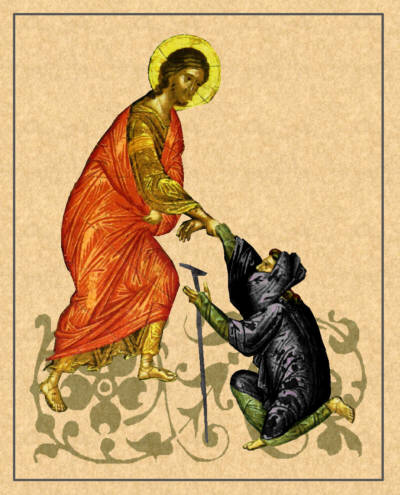
In honor of the Feast of the Conversion of St. Paul, this is the short version of my own “conversion” experience. I’m running out of feast day, but here it is anyway.

After a long and shady history, I, a baptized-but-fallen-away-Episcopalian-turned-born-again-Christian, ended up marrying Jerry, a cradle Catholic. I went to Mass with him regularly at first, but attended services at my Pentecostal church as well. Eventually, I grew weary of the Catholic Mass, and just stuck with my Pentecostal church. On Sundays, then, we went our separate ways.

In the years since I had met Jerry and had attended Mass with him, I had become more and more anti-Catholic.  I’m not sure why, exactly, but I was convinced that the Catholic Church had some things backwards, or inside out, or downright wrong.

So when the first paperback version of the Catechism of the Catholic Church came out, I purchased one and began to read it. I thought this was my ticket to proving that the Church was just plain wrong about many doctrinal issues. I looked up various subjects in the index to see what errors the Church was making. To my surprise, everything I read made sense, seemed to fit into what I considered to be correct Christian thinking, and was beautifully written, too. Finding nothing with which to disagree, I quietly put the book on the shelf, not wanting to even entertain the gnawing thought in the back of my mind that perhaps it wouldn’t be so bad to be Catholic.

Along the line, I met Liz. It was t-ball that brought us together.  Her son and Ruthie were the same age, and were on the same t-ball team. The kids were young enough that when we took them to the practices, most parents simply stayed to watch.  Liz and I soon became fast friends as we discussed our major life issues while watching the t-ball practice (and even the games) out of the corners of our eyes.

Liz was a Catholic by marriage: her husband, Pat, was a “cradle Catholic”, and she converted when they decided to get married. By the time I met her, she was 9 years into her Catholic faith, but was expressing some doubts about it. She said she wanted to know more about her faith than she had been taught in RCIA, and I encouraged her to read the Catechism.  I was still anti-Catholic, but I wanted her to find out for herself what was wrong with Catholicism.

Ha! It didn’t quite turn out that way.

Liz and I continued to dialogue about religion – about Catholic beliefs, about charismatic practices, about her doubts and my skepticism, about the faith that we both had in God. Finally, Liz came across a tape which she handed on to me: “The Mass Explained” by Fr. Larry Richards.  I listened to it carefully.  He began the talk by practically shouting, “I love the Mass!” and I thought, “Good for you, buddy.”  But he went on to address every concern I had with the Mass, and finally he came to that point about the Real Presence of Jesus in the Eucharist…

Now, I had been to Mass with Jerry many times. I’m sure he at one point said something to me about the Real Presence, but I have no recollection of it.  Then it came up one day in a conversation with Liz, and it was like a lightning bolt: Catholics actually believe that Jesus is truly present in that little wafer? But there was no skepticism in my reaction; it was simply a revelation to me.  And my immediate response was to say that I had no problem with Catholics holding that belief; whether it was true or not, I felt, we should all treat “communion” as if it were truly and really Jesus.

I had read a couple of things defending the Real Presence, but nothing that really convinced me of its scriptural validity. But here came Fr. Larry Richards, defending that belief with John Chapter 6. The light bulb came on for me then. I knew the passage; I was a “Bible” Christian, after all!  Finally, I realized how much sense it made. The few times that passage had come up in conversation with other Protestants, their immediate qualification of it was that “of course, he’s speaking symbolically.” This had never made sense to me, especially coming from a denomination that emphasized a fundamentalist, literalistic interpretation of the Bible.  “This is my body,” Jesus said. And they said he was speaking symbolically.  Why? Why was it that every other passage of Scripture was interpreted literally except for this one?

As I listened to that tape, I found myself getting excited.  My whole Christian walk had been about getting closer to Jesus. How much closer could one get than to ingest him into one’s body? I immediately felt an intense desire for the Eucharist. I thought that maybe I could become Catholic.

I quickly dismissed the notion. There was all that stuff about Mary.  I could just never get past that!  And the music…to have to listen to that stuff every week would be torture (I was right about that!).

But the nagging thought grew; I had to have Jesus.  Aha! I had the answer: I would continue to attend my church, but when we had communion (once a month), I would believe that it was really the body and blood of Jesus. A split second later, my inner voice was saying, “No, that just won’t work.” 

The thought of becoming Catholic was pushed away…for about 2 weeks. Then I listened to the tape again.  I don’t really know why I listened to it again; it’s very unlike me to listen to the same thing twice. But listen to it I did, and finally, it was clear to me that I had to become Catholic. I had to have the Eucharist.

That evening, Jerry and I sat watching the news after Ruthie had gone to bed. I was trying to figure out how to tell him about my decision. I felt humbled; I’d been so anti-Catholic, and it turned out the Church was right after all! And I’d said “No way!” to the idea of becoming Catholic from the beginning. Even now, I was resisting the idea; it was only the fact of the Real Presence of Jesus in the Eucharist that was drawing me in.

Finally, I made the leap. “Honey,” I blurted, “I need to talk to you about something.”

He heard something in my voice I wasn’t aware of, because he turned to me instantly with a look of concern.  “What is it?” he asked, muting the TV.

It was still hard to get the words out.

“I think I can do this Catholic thing,” I said. Jerry's jaw hit the floor.

The rest is history.

I was received into the Catholic Church at the Easter Vigil in 2002.


Tuesday, January 24, 2012

Why I Promote the EF Mass


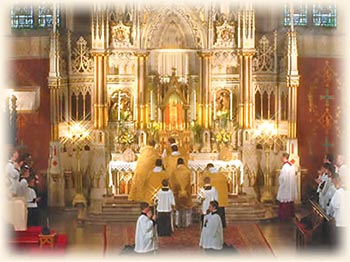
You may have noticed that I am a tireless promoter of the Extraordinary Form of the Mass.

In fact, I really think “promoting” the EF Mass is not enough. I think instruction and participation in the EF Mass really should be required of all Catholics. Yes, I know, that’s pretty extreme. I’ll try to explain.

I barely know how to express what I feel when I attend an EF Mass. I find it hauntingly beautiful, spiritually uplifting, other-worldly…a host of other adjectives. Perhaps the word I’m searching for is – wait for it! – “ineffable”? Let’s see: “Ineffable: Too great or extreme to be expressed or described in words; too sacred to be uttered”.  Yes, that pretty well sums it up.

But these “feelings” I get at the EF Mass are not the reason why I think the EF Mass needs to be promoted, explained, and offered to the Catholics who’ve never experienced it. Oh yes, I do want others to feel what I feel, but it is certainly possible that some will never get that sense of ineffability. Still, they need to have the experience. They need to understand more about the EF Mass.

Why? Because we do not remain children all our lives.  And because it is essential to our Catholic identity.

 About this we have much to say, and it is difficult to explain, for you have become sluggish in hearing. Although you should be teachers by this time, you need to have someone teach you again the basic elements of the utterances of God. You need milk, (and) not solid food. Everyone who lives on milk lacks experience of the word of righteousness, for he is a child. But solid food is for the mature, for those whose faculties are trained by practice to discern good and evil.  (Hebrews 5:11-14)

Many years ago, I worked at a daycare center. One little girl was in a serious car accident at age 3; she’d been badly burned and almost died, and recuperated at home for months. Then came the big day when she returned, scars and all. And she arrived with a problem her mom wanted us to help correct: she would consume only milk. She did not want to eat any solid food. This was the result of her trauma, the pain she experienced, the fact that she could not tolerate solid food for a while, etc. Now she was 4 years old, thin as a rail, and she needed to eat “real” food. Slowly we were able to wean her away from her milk and get her to eat the same foods the other children were offered for lunch and snack.

But this little girl was resistant to our efforts. VERY resistant.  She wanted her milk. And so are many adults in our Church resistant to the “solid food” of “real” worship. They want their bottle of milk, the “comfortable" Mass they’ve become accustomed to, with the 4-hymn sandwich, the fluffy homily, and the feel-good atmosphere. They don’t want to be challenged, they don’t want to have to chew on the meat of some spiritual truth, and they don’t want to have to think about what the Mass really means. They “know all that” – but not really.

I know there are devout people who attend the Novus Ordo Mass and have a healthy spiritual life. Despite liturgical abuses and impoverished homilies, they experience some sense of the ineffable in the NO Mass. And these people have expressed this thought to me, wondering why I still push the EF Mass; they assure me that they are indeed being challenged and are growing spiritually. I believe them.

BUT…the Mass is where earth touches Heaven; Mass should give us a glimpse of Heaven, at least in some small sense.  I want that glimpse to be as clear and sharp as possible, and I think the EF Mass accomplishes that task better than the Novus Ordo.

Consider this analogy: Think of best vacation spot you’ve ever visited (or the most sublime sunset you’ve experienced, or the most exquisite meal you’ve ever eaten; any indescribable experience will do, but let’s stick with the vacation analogy). Now imagine describing this vacation spot and your experience of it to someone who has never been there. Your words will not substitute for their own personal experience. They may say, “Oh yes, I went to a place like that one time”, or “Yes, I can imagine how beautiful that would be.” But their imagination will fall short of the actual experience.  If you have photos, that will help – it will bring their experience close to yours. And video footage will bring them even closer. But still, they will not have experienced the physical reality of that vacation spot.

It’s kind of the same thing with Heaven. We can’t experience Heaven here on earth.

           [A]s it is written: “What eye has not seen, and ear has not heard, and what
           has not entered the human heart, what God has prepared for those who 
           love him,” this God has revealed to us through the Spirit (1 Corinthians 
           2:9, citing Isaiah 64:3)

But the Mass can supply the spiritual equivalent of some of those verbal descriptions, photos, and video clips. The Mass is supposed to help us imagine what God has prepared for us. 

Here’s a description of the beatific vision – the direct knowledge of God which the angels and the souls of the just enjoy in Heaven: 

Imagine a man in whom the tumult of the flesh goes silent, in whom the images of earth, of water, of air and of the skies cease to resound. His soul turns quiet and, self-reflecting no longer, it transcends itself. Dreams and visions end. So too does all speech and every gesture, everything in fact which comes to be only to pass away. All these things cry out: "We did not make ourselves. It is the Eternal One who made us." And after they have said this, think of them falling silent, turning to listen to the One Who created them. And imagine Him speaking. Speaking Himself, so that we could hear His word, not in the language of the flesh, not through the speech of an angel, not by way of a rattling cloud or a mysterious parable. But Himself. The One Whom we love in everything. Imagine we could hear Him without them. Reaching out with speeding thought we come to Him, to the Eternal Wisdom which outlasts everything. And imagine if sight of Him were kept available, while all lesser sights were taken away. Think of this encounter, seizing, absorbing, drawing the witness into the depths of joy. Eternal life would be of a kind with this moment of understanding. (from Book IX of St. Augustine’s Confessions)

Now, that’s Heaven.  It’s not the Disneyland Heaven we describe to little children, who can only tolerate “milk”. It is the Heaven of the justified, purified soul, which yearns for and finally obtains the beatific vision. 

The EF Mass brings us closer to that Heavenly reality. It is structured to reach ever upward, whereas the NO has the tendency to be bogged down in human affairs and focus on our own earthly existence. (Yes, I know, the NO can be said reverently and experienced at a higher level than most people do, but it is also much more susceptible to liturgical abuse and a focus on the human rather than the divine.) 

I want the EF Mass available to everyone, not just to me. I want it introduced, explained, promoted, and provided for all the faithful. I want this because the Eucharist is the source and summit of our Christian lives, because the Mass is our highest form of worship, and because the Sacred Liturgy is who we are as Catholics. 

Our “source and summit” do not flow from simple ditties sung to folk guitar accompaniment; our highest form of worship is not dignified by liturgical dance, hand-clapping, foot-tapping music, or impromptu prayers ad-libbed by a Father Feelgood; and our Catholic identity is not captured by imitating Protestant worship that lacks the fundamental understanding of the Real Presence of Jesus in the Eucharist, or the true understanding of the Church as the Bride of Christ.

I want the EF Mass because by saving the liturgy, we will save the world.

How about you? Are you ready for some solid food?


Monday, January 23, 2012

The End of Catholic Hospitals?


On the heels of the DHHS announcement that, essentially, there will be no “conscience clause” for insurance providers to decline to pay for artificial contraception, Catholic HealthCare West says it’s changing its name and dropping its affiliation with the Catholic Church. Not too surprising, is it? (Hat-tip to veneremurcernui blog!)

Although my initial reaction was dismay, my second thought was, “What’s the difference?” (See my previous posts on Catholic hospitals here and here.) I am convinced that “Catholic” hospitals and hospital systems are not Catholic anyway, despite the lip service they give to Catholic teaching. We had Sr. Carol Keehan of the Catholic Health Association supporting Obamacare in the first place, contradicting the bishops’ misgivings; and we had Sr. Margaret McBride giving permission for abortion at a Catholic hospital in Arizona in 2010, with everyone then surprised that she had excommunicated herself and that the hospital was stripped of its “Catholic” affiliation.

Also in 2010, Bishop Robert F. Vasa, then of the Diocese of Baker, requested that St. Charles Medical Center in Bend, Oregon, drop its “Catholic” identification because of its history of performing tubal ligations. A National Catholic Register article pointed out that this may have been the “tip of the iceberg” in terms of rampant disregard of the Ethical Religious Directives’ explicit ban of tubal ligations at Catholic Hospitals.

Bishop Vasa noted that during the course of his negotiations with St. Charles, the hospital’s chief executive officer had been in contact with two or three very large Catholic health-care systems, and their question to him was: “Why did you tell the bishop you were doing this?”

The bishop was told that administrators in other Catholic health systems said, in essence, “This information should not have been shared so openly with the bishop.” (Read more here)

It seems to me that very few Catholic hospitals are actually run by Catholics, and those that are seem to be led by dissident sisters. And as I have noted previously, most of the websites of Catholic hospitals and hospital systems now do not explicitly mention the Ethical and Religious Directives (ERD’s) to which they are supposed to adhere. But a news article about Catholic HealthCare West’s dropping its Catholic affiliation maintains (all emphases mine):

The change will have no effect on any patients or the medical care provided at the 25 Catholic and 15 secular hospitals in the system.

Really?! Then either those 25 Catholic hospitals are not currently adhering to the ERD’s, or they are following them and are not going to change with the name. I hate to be a pessimist, but I’m betting on the former. The article continues:

But executives hope it will make it easier to merge or affiliate with other hospitals, doctors’ practices and other health-care providers.

In the past few years, proposed mergers between Catholic and secular hospitals in Louisville, Ky., and Sierra Vista, Ariz., have collapsed in part because of concerns about the church’s bans on abortion, in vitro fertilization and sterilization.

Other mergers have succeeded only with unusual contortions, such as in Troy, N.Y., where a separately licensed maternity ward free from Catholic doctrine was created on the second floor of a secular hospital taken over by a Catholic system. In Seattle, Swedish Medical Center last fall agreed to fund a Planned Parenthood office next door to quell objections about its planned affiliation with a Catholic system.

So…it’s all about money? (I ask in innocent surprise.)

Lloyd Dean, the president and CEO of Catholic Healthcare West, said the concerns about his system’s Catholic affiliation have hampered some potential deals.

“I have been contacted over the last couple of years by many, many different constituencies who have an interest in Catholic Healthcare West and what we have accomplished,” Dean said. “But one of the things when we get down to what I’ll call the real discussions as they confer with their boards is, ‘What does the future mean if we’re a non-Catholic entity? Will we have to become Catholic? What will be the Catholic influence?’ “

The San Francisco-based system, which has $11 billion in revenues, making it the fifth-largest in the country, is seeking to triple in size. It treated 6.2 million patients last year.

Yep. It’s all about money.

As of Monday, the system’s new name will be Dignity Health. Dean said the system’s change to a nondenominational board will create “a tremendous opportunity that will help accelerate our growth.”

And do you really think a “nondenominational board” will be able and willing to maintain the Catholicity of any truly Catholic hospitals within the system? Oh well, that is perhaps a moot point anyway…

In the last part of the article, we find this information:

Catholic Healthcare West leaders said the change has been in development since 2009, when it was raised by the sisters. They said they consulted with Archbishop George Niederauer of San Francisco and he determined the governance change was consistent with the church’s teachings and that it could proceed.

Future secular hospitals added to the system will be required to adhere to the “Statement of Common Values” that apply to Catholic Healthcare West’s secular hospitals. In addition to abortions, those rules prohibit in vitro fertilizations but not sterilizations such as tubal ligations.

What?! Well, we can heave a sigh of relief that abortions will not be permitted, nor in vitro fertilizations. But not sterilizations? What’s up with that? And why do I have a sneaking suspicion that these hospitals’ pharmacies will be filling prescriptions for birth control pills and contraceptive devices? And, quite likely, “emergency contraception” will also be provided, since that’s mandated in many states now anyway.

The kiss of death for Catholic hospitals.
And yet, as Catholics we are now outraged (well, some of us are, anyway) that the Department of Health and Human Services, led by “Katholic” Kathleen Sebelius, will give the Catholic Church one year – a whole year! – to come to terms with the fact that it will have to violate its conscience with regard to paying for contraception. To add insult to injury, a statement issued by Sebelius notes:

This additional year will allow these organizations more time and flexibility to adapt to this new rule

In other words, the Obama administration will allow the Catholic Church one year of hand-wringing before insisting on compliance, but it’s not going to change anything.

 O God, please give our bishops the strength and wisdom to do more than just whine about it, because Obama and Sebelius are counting on their ineffectiveness. Sigh.

I wrote in a previous post:

So what is the “next step” for Catholic medical care? The cards are stacked against it, especially given the Obama administration’s stance on conscience clauses and health care in general; but some of those cards are, sadly, part of the Catholic deck. This suggests to me that a strong program of catechesis is necessary in order to bring errant-thinking Catholics back into the fold. Too long have the faithful been allowed – and in some cases, even taught – that it is okay to disagree with the Church on artificial contraception, sterilization, in vitro fertilization, and even abortion. In the almost ten years I have been Catholic, I have heard virtually no teaching on the evils of artificial contraception and sterilization from my parish priests. Although my experience is admittedly limited, a number of friends, acquaintances, and family members affirm my suspicion that this is not a topic anyone wants discussed. That would be tantamount to declaring that “the emperor has no clothes”.

And now Obama has completely thrown off any semblance of sympathy for religious freedom. Indeed, everyone can now see that the emperor has no clothes.

Not only that, he has no shame.

Be sure to watch this episode of The Vortex, too.


Will the Church Burn Incense to False Idols?


A friend sent me this report of a homily given yesterday, Sunday, January 22.

Yesterday was the third Sunday after Epiphany in the old calendar, and the Gospel reading for the EF Mass was Matthew 8:1-13, concerning two men who approached Jesus - the observant (but leprous) Jew and the humble Gentile (and servant of Caesar). The homilist began by highlighting these two men.  He went on as follows (my paraphrase of his homily):
In the days leading up to this Sunday, the Church commemorated four martyrs: St. Fabian (pope and martyr), St. Sebastian (martyr soldier), St. Agnes (child virgin and martyr), and St. Vincent of Saragossa (deacon and martyr). The priest presented brief sketches of their deaths in the historical context of their refusal to bow to Caesar's demands to offer sacrifice to false idols.

From there it was a relatively easy step to "connect the dots" (which the Lamestream Media assiduously refuse to do) between today's Caesar and his demands that the Church once again submit to "burning incense" to his own false idols: Universal Health Care and her two viprous daughters, Contraception and Abortion. By "connecting the dots" I mean outlining the historical record of the last few months (at least):

  • the recent US Supreme Court decision in the Hosanna-Tabor v. EEOC case, in which Caesar's advocate argued that the government's "general interest in eradicating discrimination in the workplace" wasn't sufficient (for now, at least) to justify forcing the Catholic Church to change its doctrine in regard to ordaining only men to its priesthood;
  • the recent decision by Caesar's political appointees in the Department of Health and Human Services to pass over the second-placed USCCB grant application to continue programs to combat human trafficking, in favor of lower-ranking (and non-qualifying) applicants who would also offer abortion and contraception to the victims;
  • Caesar's shocking announcement on Friday last that he would make no exemption for non-church, religious employers when it comes to requiring all private health plans to provide access to contraceptives (including abortifacient contraceptives), despite the assurances he'd earlier given to Archbishop Timothy Dolan (New York; President of USCCB) that "he [Dolan] would like his answer";
  • and the National Defense Authorization Act that Caesar quietly signed into law on New Year's Eve, empowering him to kidnap, arrest, detain, interrogate, imprison, torture, and execute - without warrant, without charges, without judicial process, without habeas corpus, without trial - even American citizens - so long as he subjectively deems them a threat to The State (i.e., domestic terrorists).
And then the homilist read Pope Benedict's Address to the US bishops of Region IV on their ad limina visit to Rome - given only 24 hours before Caesar's announcement on Friday. You can read the whole thing at the link, but here are some key phrases:

 ...that would curtail the proclamation of these truths...constricting it...suppressing it...political power or majority rule...they represent a threat...reductionist and totalitarian readings...extreme individualism...notions of freedom detached from moral truth...grave threats...radical secularism...the seriousness of these threats...attempts...to limit...the freedom of religion...to deny the right of conscientious objection...cooperation in intrinsically evil practices...signs of the times...

You could hear a pin drop.


Saturday, January 21, 2012

Ask Them What They Mean By "Choice" Blog Day

Jill Stanek is urging us all to participate in “Ask Them What They Mean by ‘Choice’” Blog Day. Jill says:
This Sunday, January 22 [the 39th anniversary of Roe v. Wade], pro-life bloggers, tweeters, facebookers, commenters, debaters, apologists, and rabble-rousers will band together to counter NARAL’s Blog for Choice Day by asking them everywhere they can, “What do you mean by that word, ‘choice’”?
Here’s my two cents’ worth on the subject of “choice”.

“Choice”, they say; they are for women’s “choice”. But what does that really mean? In 2010, a huge outcry arose over the Super Bowl ad featuring Tim Tebow and his mother Pam recounting the fact that Tim wasn’t aborted, despite doctors’ advice. As Matt Barber of LSN recently noted:
The New York-based Women’s Media Center [framed] it as an “attack on choice.” Get it? Pam Tebow chose alright; she just happened to make the wrong “choice,” and dared to share about it publicly.
"Choice" seems to mean different things to Pam Tebow and the pro-choice crowd.
Here’s another good de-bunking of the “choice” phraseology of “pro-choice” adherents. Dr. Donald DeMarco, on the Integrated Catholic Life (“Seven Deadly Fallacies in Support of Abortion”), writes about the fact that the word “choice” needs some qualification (my emphases):
… “Exercise is good,” is an unqualified statement.  If one is recovering from triple bypass surgery, certain forms of exercise are not good.
Similarly, “choice,” the most effective ploy in the pro-abortionists arsenal, is a notion that needs qualification, but is taken as absolute.  Even pro-choicers are not pro-choice about domestic violence, slavery, racism, or driving under the influence…
President Barack Obama, who is emphatically pro-choice on abortion, made sure he qualified his enthusiasm for choice on his campaign trail.  He fervently urged people to vote for him, thus qualifying their choice.
In an issue of Glamour magazine, Faye Wattleton, former president of Planned Parenthood, stated, “The right to abortion  . . . shouldn’t be a political football that candidates can kick around at will.”  But choice, she seems to forget, is an act of the will.  If women can choose abortion, why should politicians (as well as the populace) refrain from making it an election issue?  Ms. Wattleton is perfectly willing to qualify choice when it comes to politics, but not when it comes to abortion.  In the final analysis, what does being “pro-choice” really mean?
Then there’s the current horrifying story of “Mary Moe”, a pregnant mentally ill woman whose parents and social worker have been seeking a court order to force her to have an abortion. Why? Because she has a mental illness that requires a drug treatment that will be harmful to the baby she carries in her womb. A judge ruled that if Mary Moe were mentally competent, she would choose to have an abortion. The court is now in the business of reading minds?!
Why doesn’t Mary Moe’s “choice” count? Even though this woman has voiced anti-abortion sentiments, the Massachusetts Department of Mental Health and her parents are ignoring the choice she has already made. In their minds, Moe, like Pam Tebow, hasn’t made the right “choice”.
When we make a “choice” for abortion the only “sane” option, it is no longer a choice, is it?
What about Mary Moe’s unborn baby? Can we also say that if the unborn baby were “mentally competent”, he or she would choose to be aborted? I think not! Human beings have an instinct to survive; isn’t life the logical “choice” when one is confronted with death?
How, then, do we reconcile the unborn baby’s "choice" with that of the mother whose choice is abortion?
Similarly, and tragically, many pregnant women in China are forced to have abortions. There is no choice there. The course of action is chosen for them, and they are physically forced to comply. “Pro-choicers” in the US might protest that they agree this is wrong, and that this kind of forced abortion is not part of their “pro-choice” package, but “force” doesn’t have to be physical. It can be psychological manipulation, for example. See Dr. Stacy Trasanco’s articles on the soothing language used to advertise abortion and persuade women that it’s a good “choice” to make: “we’re not a clinic,” they say; it’s “natural”; “we’ll help you”. And Stacy notes, there are outright lies, as well; one abortion clinic gives this “medical” information:
If there is no embryo, why do they say there is a heartbeat? At seven weeks of pregnancy, the cells that will become the embryo start to cluster inside the gestational sac. These cells can be seen on ultrasound, but would not be visible to the naked eye. At this time, the cells that are determined to later form the heart start to “beat.” An ultrasound technician will often interpret the beating cells as a ‘heartbeat’ long before a heart develops.”
That’s a lie.
The psychological manipulation is sometimes subtle, sometimes blatant. More and more women in the US are telling their stories of their own abortions – abortions they didn’t want but were pressured to have. Go here to see more detailed descriptions of these means of pressuring women have abortions:
·         Forced Non-Choice .... “I’ll blow her brains out.” 
·         Unwanted Non-Choice ... Their Choice, Not Hers.
·         Coerced Choice ... Taken to the Clinic to Make Sure She Keeps the Appointment
·         Forced Choice ... Threats Can Escalate to Violence or Murder — the Leading Killer of Pregnant Women
So, tell me again, pro-choice folks…just what do you mean by “choice”?

See also: The Sacred Liturgy and the Sanctity of Human Life

Friday, January 20, 2012

"Catholic" Politicians: Selling Out the Church

LifeSiteNews reported on January 20 that:

Health and Human Services Secretary Kathleen Sebelius announced Friday that faith-based entities like hospitals and universities will have until August 1, 2013 to provide employees with free birth control as part of their insurance packages. The mandate will also force such groups to pay for sterilizations and, because the FDA has approved abortifacient drugs such as Ella as “contraception.”

Kathleen Sebelius is a traitor – a traitor to the faith she claims as her own: the Catholic Church.

Of course, she’s not the only “Catholic” politician who has taken part in the sell-out of the Catholic Church in the public square. She’s foremost in my mind right now, though, because she stands so clearly against the moral values of the Church on this issue which threatens to force true Catholics to “figure out how to violate our conscience”, in the words of Cardinal-elect Timothy Dolan.

Last October, Michael Voris said on a Vortex episode (“Obama and Traitorous Catholics”):

The horrendous moral path that America has marched down has been disproportionately led by Catholics – bad Catholics who have betrayed the faith.

...[P]ractically every institutionalized immorality present in America – and by extension because of the US’s cultural influence, all around the globe – is present because of a handful of traitorous Catholics here and there in key positions at critical times.

The writing has been on the wall for some time, of course. Hindsight is 20/20, but the bishops have had plenty of warning signs and plenty of time to correct Catholic politicians over the past 8 to 10 years. The issue of whether or not these politicians should be given Holy Communion has been bantered about for years. Remember back in 2004 when the bishops withheld that important letter from then-Cardinal Ratzinger regarding this issue? I hope the bishops remember, and I hope they begin to rectify the situation.

More from Voris in that October 2011 Vortex episode:

…The political traitors as well as ecclesial traitors must be dealt with and dealt with fast and in no uncertain terms. Their evil must be exposed and they must suffer the consequences for it – both for the sake of their own souls as well as the sake of others. That is THE definition of charity.

One of the things that confirms the alleged “Catholic” identity of these traitorous politicians is their reception of Holy Communion at Mass. It is the continued apparent acceptance of the validity of their claim to be “Catholic” by priests and bishops – because the bishops do not correct them, do not “call them out”. And so scandal results, because the Catholic faithful, seeing these “Catholic” politicians espousing anti-Catholic ideas and practices, think that they too can embrace these philosophies and still be part of the Body of Christ.

What does it mean to be a member of the Body of Christ?  Pope Pius XII, in his encyclical Mystici Corpus Christi (1943) establishes that Christ is the Head of His Body – the Church – and that if we view the Church as the Mystical Body of Christ, certain truths follow:

·         Christ is the Head, but is so present in the Body that the Church is, “as it were, another Christ.” (MCC, §53)

·         All of the parts of the Body are joined with one another and the Head. (MCC, §57)

·         While we are all members and are therefore important to the Body, certain members carry more authority.  In particular, Bishops, while under the authority of the Pope, are nonetheless “to be revered by the faithful as divinely appointed successors of the Apostles.” (MCC, §42)

·         The “bonds of union” that hold the Mystical Body together are “vastly superior” to those that bind the members of a physical body or a social/moral body. (MCC, §62)

Following this line of reasoning, we can conclude that, since Christ is both the Head of the Church and is perfectly present in the Body of the Church, then Christ’s authority permeates every act of teaching, governing, and leading. Christ alone has the authority to rule and govern the Church, but “our Redeemer also governs His Mystical Body in a visible and normal way through His Vicar on earth” (MCC, §40). In other words, the Pope, because he is Christ’s representative on earth, also has authority to rule, govern, and teach; and through him, so do the Bishops. 

Being a member of the Body, then, means accepting Church teaching, which today we receive through Sacred Scripture and the Magisterium of the Church. In uniting ourselves with Christ in the Holy Eucharist, we also unite ourselves with each other “by a divine, ineffable bond” (MCC, §19).  Though our personal relationship with the Lord is very important, it’s not just a matter of “me and Jesus” – it’s “we and Jesus.” And the “we” is very important:

…only those are to be included as members of the Church who have been baptized, profess the true faith, and who have not been so unfortunate as to separate themselves from the unity of the Body, or been excluded by legitimate authority for grave faults committed…And therefore, if a man refuse to hear the church, let him be considered – so the Lord commands – as a heathen and a publican. (MCC, §22, emphasis added)

Pope Pius XII remarks that, in a natural, physical body, a member (appendage or organ) may possibly be healed or cured if it is still in fact an integral part of the body.  However, if a member has been “cut off” from the body, it can’t be healed or cured (MCC, §22). Members of the Mystical Body of Christ who refuse to accept Church teaching – such as some “Catholic” politicians” – may be approaching this point of separation.

The following conclusions can be validly drawn from the points made above:  First, a person cannot be in grave sin and receive communion “worthily.” Second, a person who does not hold to Church teaching is not in communion with Christ, his representatives, or his Body. Finally, bishops are responsible for the health and well-being of their flock – their part of the Body. They must keep the strong parts strong in order to help the weak – they cannot allow the weak parts to bring the strong to ill health.

When outspoken pro-abortion (or pro-homosexual “marriage”) politicians present themselves for Holy Communion, they are not in a position to receive worthily. They are out of communion with both the Head and the Body of the Church. According to Blessed John Paul II,

…the unity of the church is damaged not only by Christians who reject or distort the truths of faith but also by those who disregard [their] moral obligation…And ever since Apostolic times, the Church’s Pastors have unambiguously condemned the behavior of those who fostered division by their teaching or their actions (Veritatis Splendor, §26).

Surely politicians who call themselves Catholic and yet publicly proclaim their support for laws that clearly violate Catholic teaching fall into this category. And surely, they should have been “unambiguously condemned” for their behavior, starting a number of years ago.

But, they weren’t. And sadly, it seems that the time has come and gone for correction of errant “Catholic” politicians. They are running amok, and the Obama administration has used them to further anti-Catholic laws and policies that undermine religious freedom in this country.

Still…better late than never.  Even if our nation is entering a dark period of persecution and immorality, at least some souls can still be saved if our shepherds will begin to truly to their job.


(Portions of the above are from my paper, “Catholic Politicians and Holy Communion”, published in Homiletic and Pastoral Review, November 2007)

Voris/RCTV and the AoD: Apples and Oranges

Dr. Ed Peters has weighed in once more with his further analysis of the adversarial situation that exists between the Archdiocese of Detroit and Michael Voris/RCTV.[i]
However, when comparing the comments of Dr. Peters and the comments of most of the bloggers who are opining on the issue (myself included), it seems to me that we’re talking apples and oranges.
Personally, I don’t believe it’s ultimately a question of Canon Law and the question of jurisdiction.  Certainly Canon Law is being used – and possibly abused – in this instance, but as I have noted elsewhere, I think most people rightly guess that there’s a not-so-hidden agenda in all of this.
Dr. Peters categorizes the various reactions to the AoD’s actions along the following lines:
(a)  protestations of Voris/RCTV’s orthodoxy

(b)  heterodox groups use the name Catholic with impunity

(c)   dissident groups known to be Catholic are not being corrected

(d)  the AOD has no ‘jurisdiction’ to issue its statement about Voris/RCTV

(e)  consternation that many small Catholic initiatives will have to change their names

(f)    insinuations that a cabal of curial holdouts from the 1970s have it in for Voris personally, that the AOD is bankrupt, that some critics of Voris/RCTV are tools of the Evil One, and so on, and so on
                                                                                                                                                
Dr. Peters maintains that the first three points are largely irrelevant; and as far as the canon legalities, he’s right. Still, my own personal opinion is that they are quite relevant – from a different perspective.

Here are my oranges to his apples:

Suppose that Voris/RCTV’s orthodoxy or “Catholicity” is truly not in question – and it seems not to be, as the AoD has not made any statement to that effect that I’m aware of, nor was a direct question about RCTV’s orthodoxy answered in the media. Suppose also that at least some heterodox groups use the name Catholic with impunity, and some dissident groups use the name and are not corrected (both of which are certainly true).

Given those premises, it seems to me that by targeting Voris/RCTV, the AoD is inviting some form of assertion (f) in Dr. Peters’ list. I’m not saying that (f) logically follows from (a), (b), and (c); I’m saying that reasonable people looking at the big picture might easily find some variation (f) to be a plausible – if not proven – explanation for the action taken by the AoD against Voris/RCTV.  

Even if it’s only a “possible” explanation, and even if it’s not true at all, appearances are important and instructive when the Faithful are seriously looking to the hierarchy for guidance. It looks like the AoD is doing something underhanded. If it is not, it would seem that more complete and clear statements of the AoD's intent and purpose are in order, especially given the high-profile nature of the situation...and especially given the fact that one is hard-pressed to argue that the RCTV programming is not "Catholic".

LifeSiteNews reported that:

When asked by LifeSiteNews what concerns the Detroit Archdiocese had about Voris and RealCatholicTV.com, Detroit Archdiocesan Director of Communications McGrath would not specify any concern other than the use of the word ‘Catholic’.

I think the Archdiocese of Detroit owes the Faithful a better explanation than that.

(See also this timeline at veneremurcernui blog.)

[i] Once again, I acknowledge that Dr. Peters has the credentials, experience, and “name” to voice well-informed opinion on this issue with regard to Canon Law, while I do not. I also don’t disagree with him about the “jurisdiction” issue, which seems to be his main concern. In other words, I have no intention of debating him on Canon Law.