Thursday, January 12, 2012

Fr.Rodiguez is Being Sued...by Bishop Ochoa

Update: Article in El Paso Times

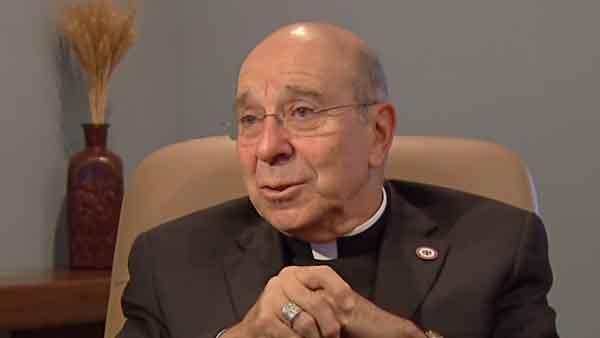
In a press release dated January 11, 2012, Bishop Armando X. Ochoa former bishop – now Administrator – of the Diocese of El Paso disclosed he is taking legal action against Fr. Michael Rodriguez, former administrator of San Juan Bautista Parish in El Paso.
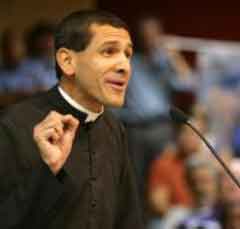
Fr. Rodriguez was removed from San Juan Bautista parish last September when the Bishop alleged that the public statements made by Fr. Rodriguez against homosexual behavior and same-sex “marriage” were a threat to the Church’s tax exempt status. LifeSiteNews ran several stories about this development ( here and here), noting that Bishop Ochoa said in a news interview at that time that Rodriquez was being transferred because his statements “raised serious issues regarding whether his participation could be attributed to the Diocese of El Paso”.
“(Father) Rodriguez has recently challenged certain city officials to participate with him in a partisan debate on issues related to an upcoming election,” said Ochoa. “This type of intervention in the political in the political process by religious organizations such as the Diocese of El Paso and San Juan Bautista Church is not permitted under Section 501 of the Internal Revenue Code.”
The Diocese of El Paso also distanced itself from Fr. Rodriguez, according to the El Paso Times. An article in that newspaper quoted a diocesan official:
"These paid advertisements are the personal views and opinions of Father Michael Rodriguez," said the Rev. Anthony C. Celino, the vicar general and moderator of the curia for the diocese.
I’ve written about Fr. Rodriguez on this blog here and here.
According to the January 11th press release, Bishop Ochoa accuses Fr. Rodriguez of “intentionally and materially failed to comply” with the financial policies of the Diocese of El Paso, and alleges that the bishop has “appealed repeatedly to Fr. Rodriguez to make a complete disclosure and a thorough accounting of is financial administration but he has refused to do so.”
The press release also notes that the Bishop has filed legal action against Fr. Rodriguez and his brother David Rodriguez to enable the diocese and the parish “to perform an accurate accounting of the amounts and use of all donated funds and to recover any funds that have been misappropriated.”
The full press release is apparently available on the Diocese of El Paso website, but I’ve been unable to get the page to load on my computer. I do, however, have the full text available as an attachment to the email sent out by David Rodriguez.
Fr. Rodriguez has released a statement in response to Bishop Ochoa’s statement; it has been sent out in an email message from David Rodriguez. Here’s the full text:
JANUARY 12, 2012 PRESS RELEASE by Fr. Michael Rodríguez

It is unfortunate that Bishop Armando Ochoa, Administrator of the Diocese of El Paso and no longer our bishop, has decided to pursue legal action against me.  Such legal action is unjust.  Over the course of 9 1/2 years as the parish priest of San Juan Bautista Catholic Church, I poured my heart and soul into caring for this parish, both in terms of temporal goods, and especially spiritual goods.  I'm confident that hundreds of my former parishioners will eagerly testify to this. 
In his January 11, 2012, press release, Bishop Ochoa stated, "Fr. Rodríguez's handling and use of donated funds has compromised the financial integrity of San Juan Bautista."  This is not true.  Bishop Ochoa's statement also refers to "Fr. Rodríguez's mishandling of funds."  Again, this is not true.  I have always honored, respected, and made good use of the financial patrimony of San Juan Bautista.  I stake my entire reputation on this claim. 
On September 20, 2011, I opened my heart to my bishop, like a son to a father, and was completely honest and forthcoming with him as to the financial affairs of San Juan Bautista.  I told him everything.  He chose not to believe me.  For the past four months, my canon lawyer has made repeated efforts to resolve this matter with Most Rev. Armando Ochoa, and he has refused. 
I have a great love for my former parish of San Juan Bautista, and my former parishioners.  I am ready to fight for and defend them, whatever the cost.  I am also ready to protect my own good name and reputation.  I have never misappropriated or misused parish funds. 
Finally, I am convinced that the real reason for my former bishop's actions against me is due to my defense of the Catholic Church's teaching with regard to homosexuality as well as my adherence to the Roman Liturgy of 1962.  If necessary, I will present prodigious evidence to support this contention. 
I will continue to do my best to be a good and holy priest, no matter the cost.  I will continue to proclaim and teach the truths of the Roman Catholic Church, especially in the area of sexual morality, no matter the cost.  I will continue to adhere to the Ancient Rite of the Roman Catholic Church, no matter the cost. 
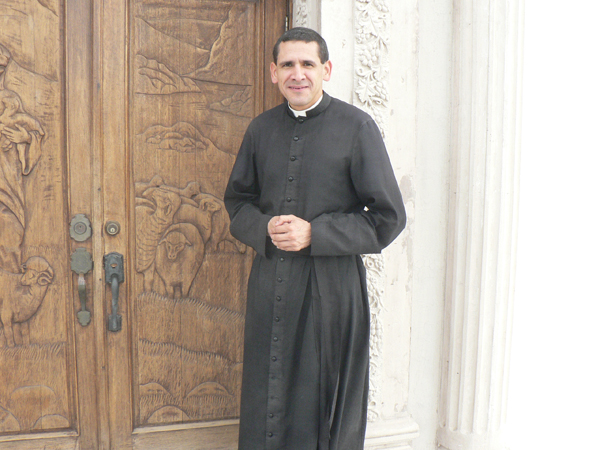
Please keep me in your prayers during this difficult trial.  Please entrust me and my priesthood to the loving protection of Sancta Dei Genetrix, the Most Holy Mother of God.  Thank you and may the good Lord bless you as this joyous Christmas season continues.

Fr. Michael Rodríguez,
Parochial Vicar, Santa Teresa de Jesús Parish
Presidio, TX            

Apology to Dr. Ed Peters

Mea culpa, mea culpa, mea maxima culpa.
Dr. Edward Peters rightfully notes that his affiliation with the Archdiocese of Detroit has never been hidden or obscured in anyway, and there was no need for him to make any further proclamation of it in his comments on the Voris/AoD issue.
In addition, it is perfectly clear that he expresses his own opinion on his blog, and he is entitled to do that without others casting aspersions on his good name…just like the rest of us.
I don’t know Dr. Peters personally, have never met him; I know him only through his blog, In the Light of the Law.  What I’ve read there suggests to me that he is a man of integrity, and that his affiliation with any particular entity would not easily influence his interpretation of and opinion on Canon Law.
I apologize for making a comment on this blog suggesting otherwise.

Why Haven't More Bishops Done This?

Just wondering...because Eponymous Flower has posted a list of 254 cardinals and bishops who have celebrated the Extraordinary Form of the Mass since Summorum Pontificum was released. That figure represents roughly 5% of the world’s 5000 bishops.  Five per cent. And how many years have passed?

You’d think that more than 5% of the bishops/cardinals would be paying attention to the wishes of the Holy Father, wouldn’t you? I would. But then, that’s just me.

In June of 2008, Catholic News Service reported on the statement made by Cardinal Dario Castrillon Hoyos that Pope Benedict XVI “would like every Catholic parish in the world to celebrate a regular Tridentine-rite Mass”. His Eminence made this public statement in London in the context of a news interview with the reporters of four major newspapers. He did so not in a personal capacity, but in his role as President of the Pontifical Commission Ecclesia Dei - in which position he was tasked to be the spokesman for the Supreme Pontiff. So this wasn't just some off-the-cuff remark or personal "wishful thinking": it revealed the mens of the Holy Father.

The CNS article went on to say (my emphases):

"This kind of worship is so noble, so beautiful," he said. "The worship, the music, the architecture, the painting, makes a whole that is a treasure. The Holy Father is willing to offer to all the people this possibility, not only for the few groups who demand it but so that everybody knows this way of celebrating the Eucharist in the Catholic Church."

… The document did not require all parishes to automatically establish a Tridentine Mass schedule, but it said that where "a group of faithful attached to the previous liturgical tradition exists stably," the pastor should "willingly accede" to their request to make the Mass available.

Cardinal Castrillon told the press conference, however, that a stable group could mean just three or four people who were not necessarily drawn from the same parish. [An assertion later clarified by the Instruction on SP, Universae Ecclesiae, in 2011.]

In Universae Ecclesiae, there is also an admonition to bishops (my emphases):

13. Diocesan Bishops, according to Canon Law, are to monitor liturgical matters in order to guarantee the common good and to ensure that everything is proceeding in peace and serenity in their Dioceses, always in agreement with the mens of the Holy Father clearly expressed by the Motu Proprio Summorum Pontificum…

14. It is the task of the Diocesan Bishop to undertake all necessary measures to ensure respect for the forma extraordinaria of the Roman Rite, according to the Motu Proprio Summorum Pontificum.

So…wouldn’t you think a few more bishops might be actively encouraging their priests to learn to offer the EF Mass?  Maybe even by example?!  Because without the bishop’s active support and example, cultivating the growth of the EF Mass in any diocese is likely to be slow going.  I do speak from some limited experience…here…and here.

On the list posted at Eponymous Flower, there are 64 American bishops; one is deceased, three are stationed in Rome, and ten are retired. That leaves 50 active bishops (out of 271) in this country who have celebrated the EF Mass – or 18%. Well, at least that’s a better percentage than world-wide.

I took a look at this from a geographical perspective, too, since I live in Eastern Oregon. There is not one single bishop from the Pacific Northwest on that list. There is one bishop in California (Bishop Cordileone of Oakland), and two from Arizona (Bishop Olmsted and  auxiliary Bishop Nevares).

There's one in Wyoming (Bishop Etienne), and one in Colorado (Bishop Conley).

Nary a one in Idaho, Nevada, Utah, or Montana.

Sigh.

If some bishops can’t quite see their way to offering the EF Mass or to encouraging their priests to accommodate the desires of the Faithful in this matter, couldn’t they at least get out of the way? If they don’t want to lead by example, could they at least stop harassing the priests who do?

"The Holy Father is not returning to the past; he is taking a treasure from the past to offer it alongside the rich celebration of the new rite," the cardinal added.

Why would anyone want to be so selfish as to withhold that treasure from the Faithful who desire it?

Just askin’.


Tuesday, January 10, 2012

Real Catholic Communication: Voris vs. AoD

There’s lots of talk about the tension between the Archdiocese of Detroit and RealCatholicTV, but there seems to me to be a singular lack of communication.
For one thing, the AoD has released several statements (one in 2008, one on December 15, 2011, and one on January 3, 2012), all of which use similar phraseology with regard to RCTV:
“…is not authorized to use the name ‘Catholic’…”
“does not have the authorization required under Church law to  identify or promote itself as Catholic”
“does not regard them as authorized to use the word Catholic..”
I like things to be laid out clearly. I’m not always good at doing that myself, of course; and sometimes I’m too good at it, which is generally called “lacking in tact” or being “uncharitable”. Some think it’s “calling a spade a spade”. But I digress.
In none of its “communications” does the AoD say that RCTV has been asked to stop using the name “Catholic”. And yet, that is what we read everywhere! Even LifeSiteNews, which has given excellent coverage to the situation, uses the phrase “drop the ‘Catholic’ name”:  
Comments on blogs indicate that many people believe that Voris and company should “be obedient” to the Archbishop. Well…what is the command which they must obey? Where’s the letter to RCTV spelling out the directive? Where’s the communication?
Sorry, but to me there is a difference between these two statements:
“RCTV is not authorized by the AoD to use the name ‘Catholic’”
“The AoD has asked RCTV to stop using the name ‘Catholic’”
That second statement has not been issued by the AoD, as far as I can tell.
In my opinion, the vague “not authorized” statements simply allow posturing by the AoD: they allow and encourage the faithful to form a negative opinion about RCTV; they allow the media to suggest that RCTV is ignoring a direct order from the AoD; and they allow the question of motivation to be dodged.
The phrase “is not authorized” begs the question “by whom?” By the archbishop? Why isn’t he communicating? According to the first LifeSiteNews story on this topic,
Voris says that communication was only one way – directives from the Archdiocese and refusal to meet with Voris or Brammer to discuss the matter.  Voris told LifeSiteNews that he has requested a meeting with Archdiocesan officials seven times to discuss the matter, but each time he has been ignored or rebuffed.
Real Catholic communication from the AoD? I think not.
Of course, the question we all really want answered is, “Why?” That question has not been addressed by the AoD (although most of us think we know the answer!) The AoD issued its January 3 statement because it had received so many inquiries about the situation – and yet the January statement says little more than the December one. The January 9th LifeSiteNews story notes that (my emphasis):
When asked by LifeSiteNews what concerns the Detroit Archdiocese had about Voris and RealCatholicTV.com, Detroit Archdiocesan Director of Communications McGrath would not specify any concern other than the use of the word ‘Catholic’.
Real Catholic communication from the AoD spokesman?…NOT.
Dr. Ed Peters has weighed in on the side of the AoD as having “jurisdiction”, and he seems to have some good points. Interestingly, though, he consistently addresses the question using the phrase “authorization to use the name ‘Catholic’”. He says:
I can add, though, that the “lack of jurisdiction” claim implies that the AOD needed “jurisdiction” to state that it “does not regard [Voris/RCTV] as being authorized to use the word ‘Catholic’ to identify or promote their public activities (Dec 2011)” …
Since when, I ask, does the AOD need “jurisdiction” to reply to inquiries made to it by third-parties regarding Voris/RCTV or to anticipate the need to respond to more such inquiries in the future?
Good point, I think, about the AoD’s right to say that it has not authorized the use of the name “Catholic” by RCTV, especially if someone calls the office and says “Does the AoD recognized this as a Catholic enterprise?” or some such question.
But is that the same as saying the AoD has the right to ask that RCTV change its name (and has the AoD in fact done that)? Maybe I’m missing something, but I’ll say it one more time: I don’t see how “not authorized” necessarily translates as “must stop using”.
I just want people to be clear in what they are saying.
Clear, honest, meaningful communication. Is that too much to ask from…dare I say it...Catholics?
Oh, and by the way, here’s the response presented on The Vortex by Michael Voris on behalf of St. Michael’s Media and RCTV. I think it’s pretty clear.


Other posts on this issue: 


Monday, January 9, 2012

A Different Breed of Bishops

This is a follow-up on my post of January 6, “Filling the Vacant Sees”.

In any situation, of course, the best thing to pray for is always God’s will – what could be more perfect than that?! Still, with regard to the appointment of a new bishop for a vacant diocese, it seems to me that we can look for models of good bishops, and pray that a new bishop meets some of the criteria of holiness set forth by the saints of the Church.

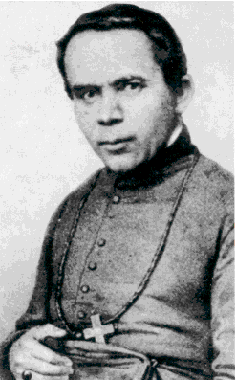
For instance, January 5th was the feast day of St. John Neumann, who was born in Bohemia in 1811 and who dedicated himself to the American missions. He was ordained a priest in New York in 1836, and eventually became bishop of Philadelphia. He died in 1860, was beatified in 1963, and was declared a saint in 1977.

In the office of readings of the Liturgy of the Hours for January 5, the second reading is from a letter from St. John Neumann to Cardinal Barnabo. It reveals a bishop who looks a lot different than some we see among us today.

It seems that although our saint had no intention of resigning from the episcopacy, another priest told him that the Holy See thought that he intended to do so, or perhaps wanted him to. Regarding this, he wrote (my emphases),

I was no little disturbed by the fear that I had done something that so displeased the Holy Father that my resignation would appear desirable to him. If this be the case, I am prepared without any hesitation to leave the episcopacy. I have taken this burden out of obedience, and I have labored with all my powers to fulfill the duties of my office, and with God’s help, as I hope, not without fruit.

He repeats at the end of the reading:

I am, indeed, prepared either to remain in the same condition in which I am at present...I am equally prepared to resign from the episcopate and to go where I may more securely prepare myself for death and for the account which must be rendered to the Divine Justice.

I desire nothing but to fulfill the wish of the Holy Father whatever it may be.

His letter shows us a bishop who is unequivocally in the service of God at the hands of the Holy Father. He talks about obedience, a fear of having displeased the Holy Father, and an acute awareness that he must be prepared to account for himself at the time of his death.  These things are a good example – a requirement, really – for all of us, clergy and laity alike. How much more important for a bishop, though. After all, “unto whomsoever much is given, of him much shall be required” (Luke 12:48). 

Yet, seldom do we see such sentiments expressed by bishops today. Instead, we sometimes see the opposite. Recent international examples that come to mind include the German bishops’ pornography scandal, and Australian Bishop William M. Morris of Toowoomba, who was finally removed by the Vatican for his dissenting views and leadership.

In the US, there are also examples that indicate a less that faithful adherence to the Church’s teachings by some of our shepherds. For instance, Bishop Armando X. Ochoa of El Paso, Texas (at the time, now of Fresno) transferred Fr. Michael Rodriguez from El Paso to a remote parish in the diocese ostensibly because of the latter’s active engagement of the local community on the issue of homosexual “marriage”. This led to some doubts about the bishop’s firmness of commitment to the Church’s teaching on that issue, as well as exposure of a heretical catechetical program in that diocese.

In the Diocese of Spokane, Bishop Blase Cupich told his priests not to pray at abortion clinics. Following media attention concerning that order, there was “clarification” and softening of the directive, but reports suggested that in private emails and messages to priests from the bishop, the order still stood. Pro-life faithful were dismayed, to say the least.

There is also the problem of bishops who fail to correct parishes (e.g., Archdiocese of Portland) which participate in such anti-Catholic events as “Gay Pride” parades or “Gay Pride” Masses (e.g., Archdiocese of Boston). The photo below bears the caption “The St. Andrew contingent at the Portland Gay Pride Parade”; even though its date 2006, it’s still on the website, so one assumes that the parish still supports that type of activity.

In my mind, these bishops are falling short of their duties, even if they want to excuse themselves on the grounds of being “pastoral” – because these days, being “pastoral” usually means avoiding coming right out and calling a sin a sin. But what’s pastoral about even appearing to condone sin? The sinner in such a case will likely continue to sin, endangering his soul.  And the “pastoral” priest or bishop may be endangering his own soul as well, as he fails to lead the faithful under his care to holiness.
So let us continue to pray that God’s will be done in filling the vacant sees. And let us keep in mind the examples set by previous bishops who are now considered saints, and pray that that sturdy stock returns to the episcopacy in great numbers. We are hearing predictions – even from the likes of Cardinal Raymond Burke and Archbishop Charles Chaput – that times of persecution of Christians are coming. We need strong, holy leaders to guide us.


Sunday, January 8, 2012

Just the Facts, Ma'am: A-Mass-ing Evidence

My husband and I went to Mass Saturday evening, January 7, 2012: the Solemnity of the Epiphany.
I will report, as objectively as possible, what we experienced.
The entrance hymn was "O Come All Ye Faithful", sung a cappella by the congregation, led by the priest as he processed to the sanctuary with one acolyte.
The offertory hymn was "We Three Kings", sung a cappella by the congregation, led by the priest.
The Communion hymn was "O Little Town of Bethlehem", played on a CD player that was placed on the altar.
There was no incense. The acolyte read the first two readings.
During the opening remarks, the priest noted that we were celebrating the feast of the Epiphany, and that this marks the day when the three Wise Men arrived at the stable to present their gifs to the Baby Jesus. And indeed, the figures of the three kings had been added to the Nativity scene in front of the altar. No mention of any other epiphany themes was made.
During the homily, we were informed that the Greek word for "epiphany" means "to show off".  Father suggested that when we look at the myriad of Nativity scenes around us – whether in paintings or displays with statues – this is what we see: Mary and Joseph are simply sitting or standing, gazing at their baby in admiration; proud and happy, they just can’t get enough of Him. They are there greeting their visitors, admiring the Babe, and "showing him off" to the Magi!
We also learned that the Magi represent us – you, me, the whole world. And just like us, when the Wise Men got to the stable, they were strangers, but then right away they “became family”.
Near the end of the homily, the priest entered into a little humor/entertainment mode by telling us what it would have been like if those wise men had been wise women.  Three wise women would have asked for directions instead of following a star; they would have arrived on time – before the birth of the baby; they would have brought a casserole, or arranged for a potluck to be held for the Holy Family; they would have brought diapers, a crib, a pacifier, formula, etc. They would have tidied up the stable and helped with the birth.
As the final note of the homily, the priest prayed a little prayer for us for the new year; it started out with something along the lines of “May you have enough tears to keep you warm and compassionate”, but I was unable to remember all the rest. So, upon returning home, I googled “enough tears to keep you compassionate”. I arrived at this site, a create-a-wedding-ceremony website, which included this option for a “benediction”:
…May God give you enough tears to keep you tender, enough hurts to keep you compassionate, enough of failure to keep your hands clenched tightly in His, and enough blessings to make certain you walk with him…
Yes, I think that’s very close to what Father prayed for us.
After he concluded his homily, Father said he wanted to make two announcements about news from the Vatican. First, he mentioned that 22 bishops/priests have been created cardinals. He said that two were from the United States, and he named them. Then he mentioned that there was one from Father’s own native country who is 85 years old and who lives in Rome, but travels often to Father’s native country; he repeated this fact a few times, because, as he also noted, this is only the second time in history that a priest from his native country has been named a cardinal.
Then Father explained about the Anglican Ordinariate. He reminded us that there are priests in the Anglican Church who are married and have children. These married priests, he said, will be able to become priests in the Catholic Church (but not bishops), and they will keep their wives and their children, and still do “the thing that married couples do”. He also mentioned that these married priests would not be able to remarry if their wives died, just like permanent deacons in the Church. He did not mention that the women running the Episcopal church across the street would not be eligible.
This was not a “Children’s Mass”.

The account I have given is true and factual, to the best of my knowledge and ability. I also maintain that the overall quality, content, and tone of the homily described, is representative of the general character of this priest’s homilies, which I have experienced frequently over the past 6 years (though less frequently in recent years, for reasons obvious and not so obvious). The general quality of liturgical practices was also representative, though I have not discussed them in detail here.
Therefore, fellow Catholics, I submit that what I experienced at Mass on January 7, 2012 in a particular parish in Eastern Oregon, is a representative specimen of one of the primary causes of the watering down of the tenets of our faith, and the dissolution of our Catholic identity.
Funny…I barely noticed the new translation…


Saturday, January 7, 2012

Extending the Effulgence of the Epiphany

(Okay, yes, I used the word "effulgence" for the alliteration effect. But it fits!...er phits?)


I like celebrating a feast - such as the Epiphany - on the day/date the Church has historically set for it; there is always a reason for the set date, and we lose that special meaning when the feast is transferred to the next Sunday. I find it distressing that this happens with such regularity in the US! And that’s beside the damage done by compartmentalizing the faith: all things liturgical are relegated to Sundays, and maybe Wednesday evenings during Religious Education, if we can present it at a 1st grade level…
But despite that, I am enjoying a prolonged celebration of Epiphany this year. Epiphany is really celebrated on January 6, and in the novus ordo Mass in the US it will be celebrated on Sunday January 8th.  Though no EF Mass (or NO Mass for the Solemnity of the Epiphany, for that matter) was available for me to attend on the 6th, I still prayed the Divine Office for that feast, read the epistle and Gospel for that Mass, and even sang the propers. And since no EF Mass will be available to me this Sunday, I will hear about the Epiphany again at the NO Mass I attend. In between the two Masses, I am still thinking about the Epiphany.
A commentary I read this year pointed out that the Epiphany is not something which happened on one day, like the Nativity of Our Lord. The epiphany – the revelation of the divinity of Jesus, of Jesus as God – happened all though his life. The Church picks three miracles to commemorate on the feast of the Epiphany: the gifts of the Magi, the baptism of our Lord, and the changing of water to wine at the wedding feast of Cana. But every miracle Jesus performed was primarily for the purpose of demonstrating his Divinity, of revealing to the world that he was in fact the Son of God.
The readings from Matins (or vigils) of the Divine Office seemed particularly meaningful to me this year – my own little personal epiphany, I suppose! Perhaps you will find special meaning in them as well. You can read the full set here (but you must change the date to Jan. 6, choose “matins”, “seasonal”, and “English” on the menus at the bottom of the screen).
Here are some excerpts:
From the Sermons of Pope St Leo (the Great)

Dearly beloved brethren, rejoice in the Lord; again I say, rejoice. But a few days are past since the solemnity of Christ's Birth, and now the glorious light of His Manifestation is breaking upon us. On that day the Virgin brought Him forth, and on this the world knew Him. The Word made Flesh was pleased to reveal Himself by degrees to those for whom He had come…
Dearly beloved brethren, we recognize in the wise men who came to worship Christ, the first-fruits of that dispensation to the Gentiles wherein we also are called and enlightened. Let us then keep this Feast with grateful hearts, in thanksgiving for our blessed hope, whereof it doth commemorate the dawn…Let all observance, then, be paid to this most sacred day, whereon the Author of our salvation was made manifest, and as the wise men fell down and worshipped Him in the manger, so let us fall down and worship Him enthroned Almighty in heaven. As they also opened their treasures and presented unto Him mystic and symbolic gifts, so let us strive to open our hearts to Him, and offer Him from thence some worthy offering.
From a Homily by Pope St Gregory the GreatDearly beloved brethren, hear ye from the Gospel lesson how, when the King of heaven was born, the king of earth was troubled? The heights of heaven are opened and the depths of earth are stirred. Let us now consider the question, why, when the Redeemer was born, an angel brought the news to the shepherds of Judea, but a star led the wise men of the East to worship Him. It seemeth as if the Jews as reasonable creatures received a revelation from a reasonable being, that is, an angel, but the Gentiles without, being as brutes, are roused not by a voice, but by a sign, that is, a star. Hence Paul hath it: a sign, not to them that believe, but to them that believe not but prophesying serveth not for them that believe not, but for them which believe. 1 Cor. xiv. 22. So the prophesying, that is, of the angel was given to them that believed, and the sign to them that believed not.
Thus also we remark that afterwards the Redeemer was preached among the Gentiles not by Himself, but by His Apostles, even as, when a little Child, He is shown to them, not by the voice of angels, but merely by the vision of a star. When He Himself had begun to speak He was made known to us by speakers, but when He lay silent in the manger, by that silent testimony in heaven. But whether we consider the signs which accompanied His birth or His death, this thing is wonderful, namely, the hardness of heart of the Jews, who would not believe in Him either for prophesying or for miracles.
All things which He had made, bore witness that their Maker was come. Let me reckon them after the manner of men. The heavens knew that He was God, and sent a star to shine over where He lay. The sea knew it, and bore Him up when He walked upon it. The earth knew it, and quaked when He died. The sun knew it, and was darkened. The rocks and walls knew it, and rent at the hour of His death. Hell knew it, and gave up the dead that were in it. And yet up to this very hour the hearts of the unbelieving Jews will not acknowledge that He to Whom all nature testified is their God, and, being more hardened than the rocks, refuse to be rent by repentance.