 I was alerted to an
interesting article at New Liturgical Movement: “Cathedral: Home for Liturgy
of the Hours” by Matthew Alderman.
I was alerted to an
interesting article at New Liturgical Movement: “Cathedral: Home for Liturgy
of the Hours” by Matthew Alderman.
Mr. Alderman suggests that a question that should be asked
in designing a cathedral is, “What makes a church a cathedral?”
Of course, there is the obvious answer that the presence of
the bishop’s cathedra makes a
cathedral, but there’s more to it than that. Mr. Alderman points to Westminster
Cathedral as an example (my emphases
throughout):
It is instructive to compare
the liturgical milieu that informed Westminster Cathedral’s establishment in
1895, with that of a typical large American diocese. Part of the problem is of
course a diminished sense of the
differences between Mass as celebrated by a bishop (though it is still laid out
in the Ordinary Form’s Ceremonial of Bishops) and a priest’s mass, but
these are ultimately matters of degree rather than quality. The most
significant difference, in my mind, lies in the inclusion or exclusion of the Liturgy of the Hours as prayed by a
community.
…Cardinal Vaughn saw the Office
as essential to the efficacy of “a live
Cathedral,” a missionary presence at the heart of a very secular city,
“functioning […] on behalf of others and winning them graces.” …[H]e argued
that this public prayer was “the highest function of the apostolic calling.” In
this regard, Westminster Cathedral started out not much different than our own
standard American cathedral. Being a mission territory, America got out of the habit of having cathedral chapters capable
of singing the Office…
 |
| Choir stalls: ideal configuration for singing the Divine Office |
For instance, consider the history of theDiocese of Baker. Long distances still separate parishes within the diocese;
how much more those distances must have contributed to deterioration of the
liturgy in times when travel was much more restricted! In sparsely populated
Eastern Oregon, I’m sure there weren’t too many of the faithful who were trained to sing
Gregorian chant propers at Mass. In addition, the Protestant churches springing
up probably accomplished two things: pulling people away from their Catholic
faith, and encouraging Catholics to substitutes hymns for the chants at Mass.
But the singing of the Divine Office in the cathedral parish
could be of great benefit to the community. Mr. Alderman notes:
…besides the spiritual graces
attendant on placing the full Office at the heart of a diocesan community, there is also considerable evangelical and apostolic merit to the practice…[S]uch a living,
breathing exemplar of the movement of sanctified
time could be a lightning-rod for an explosion of religious revival. It
would also represent a tangible way of fulfilling the Second Vatican Council's goal of encouraging the faithful to regularly
participate in the Liturgy of the Hours…The Council recommended:
Pastors
of souls should see to it that the chief hours, especially Vespers, are
celebrated in common in church on Sundays and the more solemn feasts. And the
laity, too, are encouraged to recite the Divine Office, either with the
priests, or among themselves, or even individually. (Par. 100)
If this is true of parish
churches, how much more it should be
of the cathedral church of every
diocese!
 I can’t speak for other dioceses, but the role of the
cathedral church is something that seems to be severely neglected in the
Diocese of Baker. I’ve touched on that here
and here;
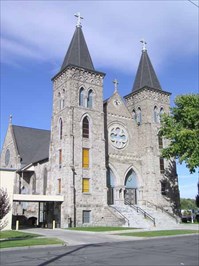
St. Francis de Sales Cathedral seems to be more of a historic church than the
active and “living” center of the Diocese. The last priestly ordination did not
take place at the Cathedral. As for episcopal ordinations…hmph! As noted
elsewhere, Bishop Robert F. Vasa’s ordination took place in a rodeo arena, and
Bishop-elect Liam Cary’s will take place in
I can’t speak for other dioceses, but the role of the
cathedral church is something that seems to be severely neglected in the
Diocese of Baker. I’ve touched on that here
and here;
St. Francis de Sales Cathedral seems to be more of a historic church than the
active and “living” center of the Diocese. The last priestly ordination did not
take place at the Cathedral. As for episcopal ordinations…hmph! As noted
elsewhere, Bishop Robert F. Vasa’s ordination took place in a rodeo arena, and
Bishop-elect Liam Cary’s will take place in
Wouldn’t it be nice to see some semblance of cathedral-icity
restored to St. Francis de Sales Cathedral?
Related:
Why a Bishop Should Be Ordained in His Cathedral
For related
posts, click on the “Bishop Liam Cary Posts” tab at the top of the page.