Tuesday, November 6, 2012

Get Ready for the Really Bad Stuff


In 2 Samuel 11-12, we find the story of David and Bathsheba.  

To recap: David saw Bathsheba and desired her. She became pregnant by him; to hide his misdeed, David recalled Bathsheba’s husband, Uriah, from battle, presuming that he would have relations with his wife and would then assume that he himself was the father of the child.

Uriah, however, did not sleep with his wife, and in desperation, David had his general put Uriah in the front line of battle so that he would be killed. This did in fact happen, and then David took Bathsheba as his wife.

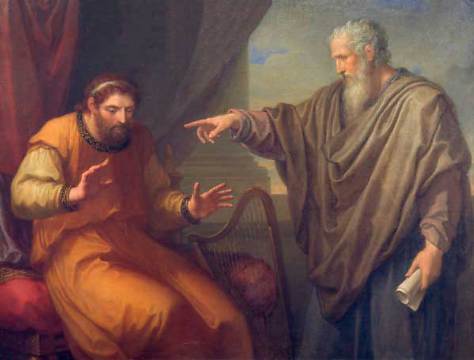
The prophet Nathan, hearing from God, went to David with a story of a man who stole his neighbor’s beloved ewe lamb, and David was brought to the realization of what he had done. Nathan announced God’s judgment, which included the death of the child born to Bathsheba.

The LORD struck the child that the wife of Uriah had borne to David, and it became desperately ill.  David besought God for the child. He kept a fast, retiring for the night to lie on the ground clothed in sackcloth. The elders of his house stood beside him urging him to rise from the ground; but he would not, nor would he take food with them.  

On the seventh day, the child died. David's servants, however, were afraid to tell him that the child was dead, for they said: "When the child was alive, we spoke to him, but he would not listen to what we said. How can we tell him the child is dead? He may do some harm!" But David noticed his servants whispering among themselves and realized that the child was dead. He asked his servants, "Is the child dead?" They replied, "Yes, he is."

Rising from the ground, David washed and anointed himself, and changed his clothes. Then he went to the house of the LORD and worshiped. He returned to his own house, where at his request food was set before him, and he ate. His servants said to him: "What is this you are doing? While the child was living, you fasted and wept and kept vigil; now that the child is dead, you rise and take food." He replied: "While the child was living, I fasted and wept, thinking, 'Perhaps the LORD will grant me the child's life.' But now he is dead. Why should I fast? Can I bring him back again? I shall go to him, but he will not return to me."

And so, similarly, we see the death of our hope that Obama would be defeated in this election. So my husband and I celebrated even before the election returns were being discussed, because, after all, we knew that God’s will would be done. The election was over. 

Of course, it’s a little different than David’s baby dying. We will see millions more babies die because of Obama’s re-election. We can and must continue to pray and fast for an end to Obama’s schemes and plans to destroy our children and our country. We must continue to pray and fast for our bishops and priests – that they will be strong, that they will begin, finally, to adequately teach the faith, and that they will restore the liturgy to its proper preeminence.

I think perhaps God wants to purge and purify the Church; maybe that’s why He allowed Obama to win. Maybe this is Nathan accusing our shepherds of their dereliction of duty. The persecution has begun, and it will only get worse now. If Romney had won, I’m afraid our shepherds might have been tempted to slip back into complacency. But with Obama back for four more years, they will have to get tough or get out. Persecution...

And then there are all those little souls, the little unborn babies who will be torn apart in the name of “women’s health”. (I can't bring myself to post a photo of an aborted baby.) Perhaps those little dead bodies will begin to weigh on the bishops’ hearts, and lead them into more honest and forthright discussions of the issues – as we have seen from some of the stronger ones recently. When will the USCCB give up its “social justice” nonsense and start defending life?

Purging. Half of the laity is no longer Catholic. That’s not news. But tonight we see the repercussions of that. And why aren’t they Catholic? Because of Father Friendly and Bishop Feel-Good, who were afraid to offend anyone. Who were afraid to talk about “politics” because the Government said not to. Who invited a murdering, baby-killing president to dinner.

Can’t wait to hear what Michael Voris has to say about this tomorrow. I know he’ll be much more articulate than I am as I ramble in my daze. "Social justice." "Gay marriage". Contraception. Economic collapse. Persecution.

Sigh.

Tradition and the New Evangelization

From Catholic News Service:

Sunday, November 4, 2012

Motivated by Fear or Love? Or Both?

Well...I wasn't planning to post anything, but this was too good to pass up. Thanks, Fr. Eric Andersen!


A homily by Fr. Eric M. Andersen, Sacred Heart- St. Louis in Gervais, Oregon (my emphases)

Nov 4th, 2012

Dominica XXXI Per Annum, Anno B

“You shall love the Lord your God with all your heart, with all your soul, with all your mind, and with all your strength.”

Blessed Agnes of Langeac, a French Dominican nun of the 17th century, was known, as prioress for “recommending to her religious respect and fervor in their relations with God, reminding them of these words of Holy Scripture, Accursed be he that doth the work of God with negligence [Jeremiah 48]. A sister of the community named Angelique died. The pious Superior was praying near her tomb, when she suddenly saw the deceased sister before her, dressed in the religious habit; she felt at the same time as though a flame of fire touched her face. Sister Angelique thanked her for having stimulated her to fervor, and particularly for having frequently made her repeat during life these words, Accursed be he that doth the work of God with negligence. “Continue Mother,” she added, “to urge the sisters to fervor; let them serve God with the utmost diligence, love Him with their whole heart, and with all the power of their soul. If they could but understand how rigorous are the torments of Purgatory, they would never be guilty of the least neglect” (Schouppe, Purgatory, pp. 137-138).

If they could but understand… they would never be guilty of the least neglect. This story is an example of motivation by fear. Where there is a fear of punishment, we are more likely to do what we are supposed to do. In the past, the Church often motivated people by emphasizing fear of punishment; the fear of going to hell, or the fear of languishing for centuries in purgatory. As a result, people obeyed the law of God. They obeyed the Ten Commandments, abstained from meat every Friday, went to Confession every Saturday and Mass every Sunday. They avoided committing mortal sin for fear of going to hell. Society itself upheld a high moral standard because that was the way people lived. God commanded it and people obeyed…out of fear… and out of love for God.

In 1965, Pope Paul VI changed the law that requires abstinence from meat on Fridays. He lifted the pain of mortal sin attached to this law, but he did not lift the law itself. Catholics today are still obliged to abstain from meat every Friday during the year, but now we are obliged by love. We are no longer obliged by fear. We are obliged by love. Perhaps it was naive to believe that Catholics would continue this practice out of love. Many Catholics today do abstain from meat every Friday, but I would guess that most do not. It is not a mortal sin to eat meat on Fridays except during Lent. Since it is a mortal sin during Lent, most Catholics observe this law. They do so out of fear. But why do they not do so out of love?

Let me clarify the issue. We can eat meat on Friday as long as we are doing something else that is penitential. Catholics are obliged to do penance every Friday. Canon Law specifies that this means abstaining from meat, but in the United States, we can choose another penitential practice instead, especially if a person is a vegetarian and already avoids meat. If a woman is pregnant, she is excused from this law, even during Lent. But recently the Bishop’s Conference in England ruled that there is no other option anymore for the people of England. Abstinence from meat is now mandatory every Friday throughout the year. There has been talk among the US Bishops Conference of doing the same thing in the United States. This is not a step back because Vatican II never changed the discipline. The discipline remains in place for the entire world and has always been in place since the first century (cf. Didache)

But Catholic culture has changed in practice in this regard. It is nobody’s fault here in this community. We inherit what is passed down to us. But if we look at the Church’s teaching, we see that Catholic culture actually has not changed. Perhaps we just become distant from Catholic culture when we stop practicing it. If there is no fear, can we respond out of love?  The gospel says, ““You shall love the Lord your God with all your heart, with all your soul, with all your mind, and with all your strength.” Was Paul VI naive when he said that we should do it out of love instead of fear? Did he know that millions of Catholics would not be willing to continue this out of love?

Now the question before us is this: Does love motivate us to do what we are supposed to do? Or must there be fear in order for us to obey the law of God? When I was growing up in the late 1970s and 80s, all we were taught was that God loved us. But it was a vacuous, meaningless love, and frankly I think many of us got tired of hearing about it. It became boring. It asked nothing of us in return. That kind of love doesn’t mean much because there is no sacrifice, no demands, no betrayal, no cross. We had no fear of God and no fear of consequences for our sins.

If we look at our society today, it is alarming to see how far things have fallen in the last 50 years. In many ways, there is complete disregard for the law of God. In the Church, we see so much dissent from Church teaching, widespread disrespect for the Holy Eucharist, and overall negligence toward the work of God. Remember the words of the prophet Jeremiah that Blessed Agnes of Langeac taught: Accursed be he that doth the work of God with negligence. When we hear it that way, it puts the fear of God in us.

Maybe both love and fear are necessary to motivate us. This is something for each of us to think about and pray about. For some God’s love is all they need to be fervent and zealous in their faith. For others God’s love does not motivate them. What will it take to get us to heaven? Sr. Angelique said: “If they could but understand how rigorous are the torments of Purgatory, they would never be guilty of the least neglect.”

Something for us to think about and pray about. Let us respond out of love to the law of God in the way we live our lives, in the way we spend our money, in the way we vote. Let us love the Lord our God with all our hearts, with all our souls, with all our minds, and with all our strength. 

For more homilies by Fr. Andersen, click on the tab at the top of the page.

Saturday, November 3, 2012

Prayer, Penance, and the Presidential Election

It seems like 2008 was a lifetime ago.

And it seems like society in general has been on a steep, steep decline in the last four years. I guess that’s not surprising, given the evil that is reigning in the Obama administration. Still…I find it appalling, to say the least.

For instance, in 2008, we had abortion, but not with the attitude we see on the left now. Now we even have people suggesting that killing born children might just be “morally correct” if the child might be too much of a burden on his parents.  

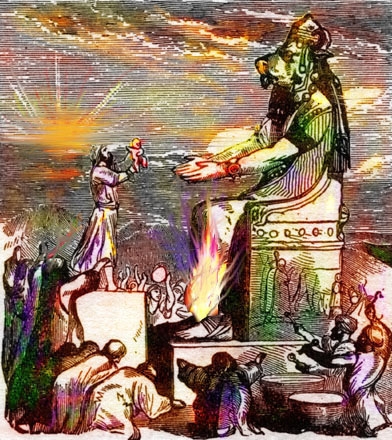
“You shall not offer any of your offspring to be immolated to Molech, thus profaning the name of your God. I am the LORD.” (Leviticus 18:21)

The liberals pooh-pooh the Ten Commandments and Old Testament injunctions against sinful behavior. But there’s a reason God had to put in writing those human activities that constitute grave sin! People, left to their own devices, slouch into sin quite easily; we see that now, today. As belief in God has receded, so has any semblance of moral uprightness. Just take a look at Leviticus 18 – the whole chapter. “You shall not”, it says. You shall not, you shall not, you shall not: have intercourse with your mother, your sister, your brother, your aunt, your uncle, your daughter-in-law... Heck, some people need to hear that now.

The "Church of no”? YES! God has to tell us “no” because we are willful children who refuse to recognize evil when we see it. Most of us realize that children who are raised without hearing the word “no” tend to become spoiled brats.  Yeah, I know, that’s a very politically incorrect thing to say these days. Child-rearing is not what it used to be.

Anyway, last night I was reading about Obama’s exhortation to his supports to “vote for revenge” against Romney. That in itself is pretty ludicrous. At the end of this article, there is a list of “related” stories. Look at the topics:


I visited a few of those…it’s disgusting. When I read the Roman Martyrology every morning, I am sometimes just aghast at the types of tortures that humans have devised to visit upon their own brothers and sisters. I feel the same kind of horror reading the comments by liberal fanatics today.

The author of the article suggests:

Throughout the campaign, Obama's base has engaged in some of the most vile, hateful, eliminationist rhetoric the American electorate has ever witnessed.

Liberals on Twitter, for example, have repeatedly called for harm to come to Romney and his supporters, with many threatening to kill the GOP nominee should he win.
Others have threatened to engage in riots and acts of domestic terrorism against the White House.

A recent ad produced by Michael Moore and MoveOn.org depicted senior citizens threatening to "burn this m*****f****r" down if Romney wins.

In short, Obama is simply encouraging his base in language they understand.

I watched that Michael Moore ad, too…oh my. I feel embarrassed for the elderly people who participated. What is the deal with profanity? Why do the libs seem to think it necessary to pepper every sentence with the “f” word? Seriously, I just don’t get it.

As far as the comments about killing, maiming, or otherwise harming political candidates, I just don’t see those kinds of comments coming from the right. Oh yes, I know there are fanatics on the right, too, but they must be a much smaller number, or less vocal, or something. Or I’m not reading the right reports.

It's not just a "slippery slope" any more...
But the left is violent, ironically enough, for all its “peace-love-kumbaya” façade. The “gay rights” political agenda is sadly violent. Go find a homosexualist website – it’s easy to find degrading videos that feature sex, sex, sex, and derogatory, violent comments about anyone who dares to suggest that homosexual behavior is a sin, or that it’s unhealthy, or that some people with same-sex attraction don’t want to be “gay”, etc. We are just not “allowed” to say such “hurtful” things…but the homosexualists seem to think there’s nothing wrong with hurling similar epithets at Christians, and even resorting to violence against them. We’re not allowed to “bully” homosexuals, but it’s okay to “bully” those who refuse to recognize homosexual behavior as “normal”.

Michael Voris has been doing a weekly update on how the presidential race is shaping up, from the perspective of the electoral vote. In the latest installment (embedded below, and worth watching) he concludes:

Romney SHOULD win by every measure there is, but we have to consider that as St. Paul says, we are not fighting a temporal war, but a spiritual one – against principalities and powers.

People supporting Obama are not supporting him because of his sterling economic policies; they are supporting him because of his ideological stances – as was made abundantly evident during the Democratic Convention, when one child-murdering supporter and sodomy supporter after another walked up to the podium and hailed this man.

We do not know how this will turn out, but we do know this: IF Obama wins, and the pace of social and cultural destruction quickens – which it most certainly will – none of it will be happening without God in Heaven allowing it.

Obama winning may in fact be His judgment on a wicked and perverse generation…not OUR judgment on who is best to occupy the White House.

So for now, I leave you with those rather disjointed thoughts. I will be devoting the next few days to prayer and penance, and will resume posting sometime late Tuesday, or perhaps Wednesday.

This program is from ChurchMilitant.TV

Friday, November 2, 2012

Priest and Ex-Priest Confuse Catholics: Vortex

Fr. Thomas Rosica
In today's (Nov. 2) episode of the Vortex (embedded below), Michael Voris explains just how far astray a Canadian priest, Fr. Thomas Rosica, has gone in interviewing defrocked ex-priest Gregory Baum on his TV show. In the process, he says a lot of things that bear repeating, or contemplating.  (The full script is here; a related article is here; and here is a 2005 article on Gregory Baum, who "has done more to help destroy the Church in Canada than any other person"; and here’s a recent LifeSiteNews article on the same interview Voris discusses here.)

Voris explains:

[I] n addition to having an excommunicated priest as his guest without ever informing the audience of that little fact, [Fr. Rosica] publically praises his guest, Gregory Baum, for his love of the Church and Christ…

…From high atop his perch over a rapidly declining and shrinking Church in Canada (think the crow’s nest on the Titanic) Fr. Rosica not only confuses the faithful by praising and lauding a former priest who thinks homosexual marriage is okay, birth control is fine, and the good Lord knows what else, he lashes out at faithful Catholics – the orthodox crowd – as he opens up a line of discussion with his excommunicate buddy…

Here is inserted a clip of the show, wherein Fr. Rosica says,

In the midst of great theological search [of Vatican II], was a deep and profound joy…and John XXIII invited that. And it’s interesting that many of those who are on the front lines, the crusaders, of the orthodoxy today – I would call it a pseudo orthodoxy – are among the most unhappy and sad and angry that I’ve ever met.

Voris responds:

Well, Fr. Rosica, first of all, we may not be all jolly and kumbaya at the destruction that you and your ilk have helped promote, but whatever may be said of the orthodox crowd, you cannot say that we are excommunicated – like that former priest sitting across from you in the interview. Better to be grumpy and upset with grace, than blissfully promoting evil and be excommunicated.

And by the way, in case it has never occurred to you, the reason one finds such anger – and it’s righteous anger – among so many faithful Catholics, is in REACTION to the damage that has been done to their loved ones in this life and quite possibly for eternity in the next, precisely because of the writings and lack of faithfulness on the part of men you are praising.

My sentiments exactly! I’ve been called “bitter” and “angry”, too. Well…yeah! There is some weakness to that – a failure to trust God completely that His Church will prevail, for instance, and a failure to remember to rejoice at all times in our salvation  – but there’s also, as Voris says, some righteous anger. Jesus did, after all, turn over the tables of the moneychangers in the temple!

Gregory Baum
It’s hard not to be angry when one stops to think about what has happened to our Catholic identity in the half-century since Vatican II commenced. And it’s hard not to be a bit disillusioned when one comes to find out that there was an intentionality to some of those detrimental changes, and that the intentions were fulfilled in what we see happening in the Church today. The fact that a priest like Gregory Baum could be praised by another priest who is ostensibly in “good standing” with the Church is ludicrous, but it is precisely an outcome of some of the wishy-washy language in and intentional misinterpretation of part of the documents of Vatican II.

Michael Voris concludes:

At this very moment, Gregory Baum is outside the community of the Church, unable to faithfully receive the sacraments – most especially the Body and Blood of Our Blessed Lord. Shouldn’t Fr. Rosica’s first and only concern be for the soul of this nearly 90 year man? Shouldn’t he be assisting him in coming back into the faith not taking a stroll down memory lane of his time at the Second Vatican Council? His time at the Second Vatican Council won’t mean a thing if he loses salvation.

And see, here is the difference, at the end of the day, between Orthodox Catholics and all the rest: Orthodox Catholics take Jesus and the Apostles at their word when they say there is a Hell and you can go there. All the non-Orthodox Catholics seem to want to dent, sidestep, downplay or ignore that.

What on earth do they think the role of the Church is in the first place? So keep calling us names and poking fun and accusing us of lacking joy as we look over the devastated vineyard…and we’ll just keep on keeping on.

Here’s the Vortex episode:

All Souls Day and Indulgences

 This is my post from last year:

Every year on November 2, Catholics in our local parish go to Mass and then visit the local Catholic cemetery. When we first moved here, I went to the Mass, but I never went to the cemetery; for one thing, it was usually a cold, windy day, and I didn’t want to brave the weather. For another thing, I simply did not understand the significance of that visit.

Now, with the experience and wisdom (ha!) gained in my whole almost-ten years of being a Catholic, I do understand – at least a little more – about that visit to the cemetery. I learned several years ago that one can gain a plenary indulgence for visiting a cemetery and offering prayers for the dead on All Souls’ Day (and actually, on any day from November 1 to November 8).  I even learned what a plenary indulgence is.

How did I learn this? Well, it was not from attending Mass on All Souls’ Day and hearing the priest talk about sin, indulgences, prayers for the dead IN PURGATORY, and the like. If anything, all I ever heard about the dead was that they were in heaven praying for us. Purgatory? Well…let’s just think happy thoughts about heaven.

No, I learned about indulgences from my spiritual director, who explained to me what they actually were, and who recommended a book, A Modern Guide to Indulgences, by Dr. Edward Peters. I read the book and found that, like all authentic Catholic teaching, the whole concept of indulgences and purgatory and praying for the dead was integrated, logical, and simply beautiful.

That visit to the cemetery after Mass on All Souls’ Day is not just something we do to “honor the memory” of the dearly departed. We don’t go there just to put flowers on graves and shed a few tears for the family and friends we’ve lost – which does nothing for the dead, but simply gives us opportunity to indulge our own sentimentality.

No, there is much more to it than that.

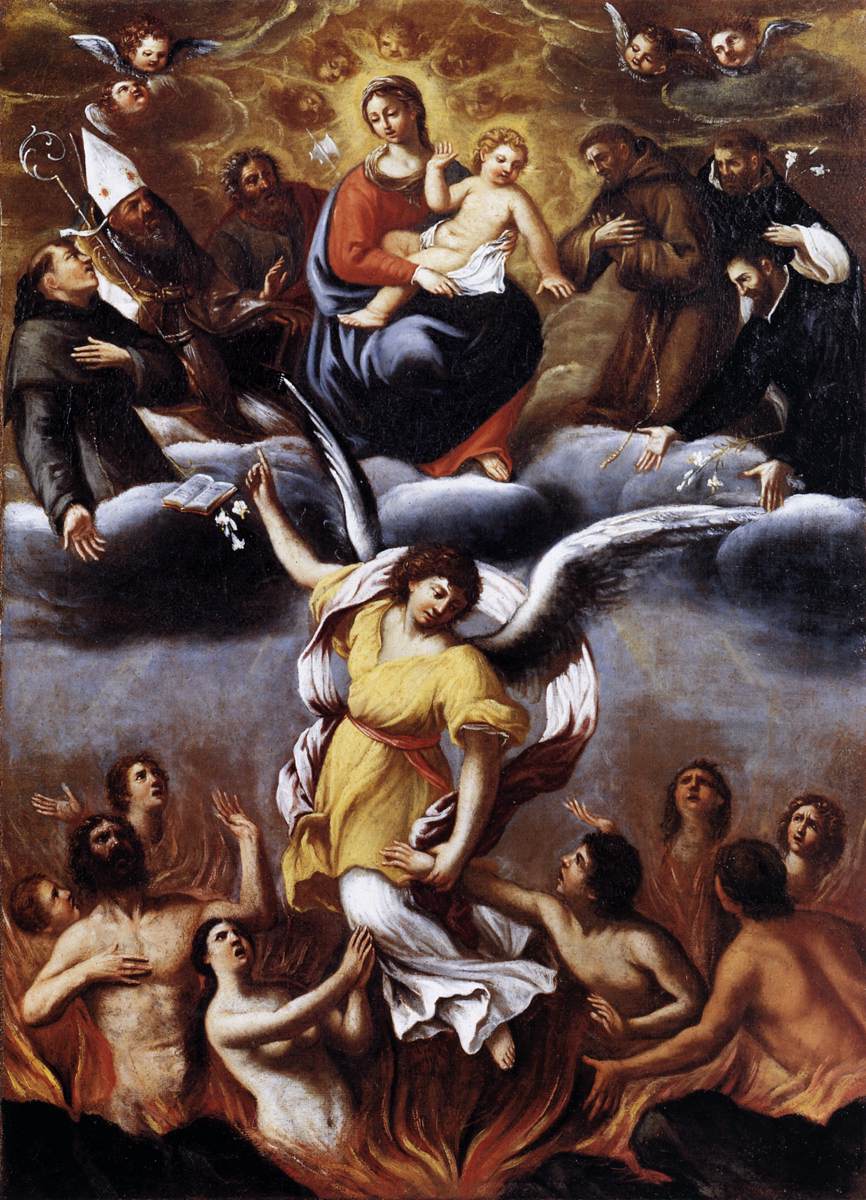
We go there to pray for their very souls. We go because there is sin in our lives, and there was sin in theirs, and we do not know whether or not these souls have gone to heaven. The Church tells us that almost certainly the deceased are in purgatory, being…well…purged…as the word tells us! They are being prepared to enter the court of the King of the Universe. And we can help them. We must help them, because they can no longer help themselves. That’s why praying for the dead is a spiritual act of mercy.

Even when I have heard people talk of purgatory, it’s been in a sort of off-hand, dismissive way, as if purgatory isn’t all that bad, and hey, you’re on your way to heaven if you at least have made it to purgatory, so no big deal. But then I read another book (I have been told by more than one person that I read too many books): Hungry Souls, by Gerard J. M. Van Den AardwegThis book makes it very clear that purgatory is real…and painful. Yes, painful. Having every one of your sins laid bare, made excruciatingly present in your mind in the sight of God…well, that’s pain. There’s lots more about the pains of purgatory in Hungry Souls. Read the book.

So…about that visit to the cemetery: through this act, we can gain graces which are passed on to the souls in purgatory, and we also gain graces for ourselves because of the act of mercy in which we participate.

There’s a catch, though. Indulgences don’t come by wishing. There’s work involved. If you read about particular partial or plenary indulgences, you will often see the phrase “under the usual conditions”. What are the “usual conditions”?

For a partial indulgence, one must:

·         Be baptized
·         Be in the state of grace
·         Have the intention to obtain the indulgence
·         Perform the works or offer prayers correctly

And for a plenary indulgence, one must:

·         Meet all the requirements of a partial indulgence
·         Not be excommunicated
·         Have no affection for sin, not even venial sin
·         Receive the sacrament of reconciliation and Holy Communion and offer prayers for the pope’s intention within 8 days before or after the indulgenced day

A true appreciation of indulgences brings one to the realization that:

·         Sin exists (!)
·         Sins must be forgiven in order to be indulgenced; that means going to confession.
·         People who die do not automatically go to heaven, no matter how much we love them!
·         Indulgences can only be granted through the Catholic Church

And finally, it is very important to know that to obtain an indulgence, one must have the intention to obtain it. I’ve noticed that older prayer books often suggest a prayer to this effect: “I wish and purpose to gain today all the indulgences which it is possible for me to gain.” When I pray that prayer, I automatically think about how long it’s been since I went to confession, because that will have some bearing on whether or not I qualify for a plenary indulgence. And both confessing my sins and obtaining an indulgence (whether for myself or for someone else) are good for my soul.

I think that if all the faithful had a greater appreciation of indulgences, there would be more visits to the confessional. I think there would be fewer funeral Masses that sound like beatification ceremonies, and more that sound like the prayer for God’s mercy that they are supposed to be.

My conclusion: The effort to obtain indulgences leads to more prayer, more awareness of sin, prayers for the dead, and the salvation of our souls. Sounds like a good thing.  Too bad we don’t hear more about it from our priests and bishops!

Requiem aeternam dona eis, Domine. Et lux perpetua luceat eis.

Thursday, November 1, 2012

Solemnity of All Saints: St. Bede

Here are readings iv, v, and vi for the office of Matins for the Solemnity of All Saints (my emphases):

From the Sermons of the Venerable Bede, Priest

Dearly beloved brethren: This day we keep, with one great cry of joy, a Feast in memory of all God's holy children; His children, whose presence is a gladness to heaven; His children, whose prayers are a blessing to earth; His children, whose victories are the crown of the Holy Church; His chosen, whose testifying is the more glorious in honour, as the agony in which it was given was the sterner in intensity, for as the dreader grew the battle, so the grander grew the fighters, and the triumph of martyrdom waxed the more incisive by the multiplicity of suffering, and the heavier the torment the heavier the prize.  
And it is our Mother, the Catholic Church, spread far and wide throughout all this planet, it is she that hath learnt, in Christ Jesus her Head, not to fear shame, nor cross, nor death, but hath waxed stronger and stronger, and, not by fighting, but by enduring, hath breathed into all that noble band who have come up to the bitter starting-post the hope of conquest and glory which hath warmed them manfully to accept the race.

Of a verity thou art blessed, O my Mother the Church! The blaze of God's mercy beateth full upon thee; thine adornment is the glorious blood of victorious Martyrs, and thy raiment the virgin whiteness of untarnished orthodoxy. Thy garlands lack neither roses nor lilies. And now, dearly beloved brethren, let each one of us strive to gain the goodly crown of one sort or the other, either the glistening whiteness of purity, or the red dye of suffering. In the army in heaven peace and war have both chaplets of their own, to crown Christ's soldiers withal.

Moreover, to this also hath the unutterable and boundless goodness of God seen, that He spreadeth not the time of working and wrestling, neither maketh it long, nor everlasting, and, as it were, but for a moment, so that in this short and scanty life there is wrestling and working, but the crown and the prize is in a life which is eternal. So the work is soon over, but the wage is paid for ever. And when the night of this world is over, the Saints are to see the clearness of the essential light, and to receive a blessedness outweighing the pangs of any torment, as testifieth the Apostle Paul, where he saith: The sufferings of this present time are not worthy to be compared with the glory which shall be revealed in us.

I found this scene of martyrdom from "Dialogue of the Camelites" quite moving: