 California
Catholic Daily recently ran
this story about Deacon John Ashmore’s homily of March 11, which pointed out
all the “failings” of the Church that were “corrected” by Vadican Too. You can
read the news article here,
and the entire sermon here.
A
personal note: Deacon Ashmore’s parish is Christ the King in Pleasant Hill,
California – the very parish where I had my first experiences of the Catholic
Mass, as a non-Catholic. It’s the parish where our marriage was “blessed” after
our annulments, and it’s the parish where our daughter was baptized. It’s also
a parish where the pastor went on to celebrating clown Masses (after we moved
to a new city, thank God!).
Here
are some excerpts (my emphases
throughout):
…I think over the period of a
couple thousand years, the church developed some institutional “money
changers.” The “rites,” that’s R-I-T-E-S, became failings in some ways. Just to
be clear, there is nothing inherently
wrong with the old rites, Latin or the Tridentine Mass. They were beautiful and mystical, but
sometimes they were so mystical that they
cut us off from the immanent reality of Jesus with us and in us.
“Nothing
inherently wrong” with the “old” rites….what a relief! It would be quite
disconcerting to find that what the Church had been doing for centuries, with
minor changes that evolved organically, was somehow “wrong”. And every fiber of
my being wants to scream that “beautiful and mystical” does not “cut us off from the immanent
reality” of Jesus!
 In my
little world of limited choices for liturgy here in Eastern Oregon, I see a few
priests who take a minimalist view of the liturgy, and the first thing they
want to minimalize is the beauty and mysticism of the Mass. They say things
like “This isn’t Rome!” when asked to implement some required element of the liturgy that has been long neglected in our
parishes. They want to emphasize the humanity
of Jesus to the detriment of our appreciation of his divinity. Their homilies focus on how Jesus was “just like us” –
which is surely important to ponder, but I am wearied by the mundane diatribes
that result. Sometimes Jesus is reduced to the level of a sinner like me! Those
“beautiful and mystical” rites help us to lift us up, to “be perfect” as Jesus
told us to be (Matthew 5:48), and to appreciate the spark of divinity in our
own souls.
Deacon
Ashmore goes on to mention the Missal he received as a Confirmation gift:
I was now, at the age of ten,
responsible to take my missal to every mass I attended, and follow the reading
and prayers as they were said by the priest. There was just one minor problem,
and it began like this: “In nomine Patris, et Filii, et Spiritus Sancti. Amen.
Introibo ad altare Dei. Ad Deum qui laetificat juventutem meam.” (That means,
“In the name of the Father, and of the Son and of the Holy Ghost. Amen. I will
go in to the Altar of God. To God, the joy of my youth.”)
This is
not a problem with the “old rites”, Deacon Ashmore. Latin is the official
language of the Church. Canon law requires seminaries to teach Latin to the
seminarians; our rite is called the Latin
rite. And every “old” hand Missal I’ve seen includes the Latin prayers and an
English translation. I’ve learned a lot of Latin just by making the comparison
between the two translations. No, the problem is not with the “old rites” or
the language; the problem is with one’s attitude toward them.
The mass was celebrated entirely in a language that none of us
understood. The priest stood with
his back to us saying words that, even if we could hear them, which we
seldom could, we didn’t understand. Missals had Latin and English translations, so those who had them tried their
best to keep up, eyes darting back and forth between the Latin and the English.
This language confusion caused some
people to just give up. People often spent their time at mass in personal
devotions like the rosary.
I fail
to understand why people want to hold on to the idea that they can never, ever
understand Latin! Nor can I understand why they want to hold on to the idea
that the priest “turns his back to us” at a Mass celebrated ad orientem. I think this is willful
ignorance. And puh-lease! “Eyes darting back and forth” between translations? “Language
confusion”? I think the real problem here is a lack of catechesis and Catholic
identity confusion.
 My eyes
dart back and forth between translations when I attend a Mass said in Spanish.
I don’t find it a problem, really. For one thing, I know what the priest is saying…not because I understand Spanish,
but because I’ve been to Mass a few times. It’s really not that difficult. The
priest does tend to say the same
prayers at every Mass, ya know! The Mass is “universal” because it’s (supposed
to be) said the same way all over the world. So even if travelers find the
language unfamiliar, they still know the rite. They should know what the priest
is praying.
The
deacon goes on to complain about a variety of things. He says that the
existence of “side altars” encouraged “the idea that any mass was more about the celebrant than the
people” and that this was “one of the pre-Vatican II failings of the church”.
Hello! The Mass is more about God than anyone else! And I maintain that the
talk-show-host mentality of the Novus Ordo has led to far more focus on the
personality of the priest than any of the rubrics of the extraordinary form.
Deacon
Ashmore also complains about that pesky communion rail that was a “physical
barrier” between the altar and the people back in the bad ol’ days before
Vaddican Too. Never mind that nowhere in any Vatican II document was removal of
that “barrier” mandated! Frankly, I see no problem with this “barrier”. It
helps us to remember that there is a difference between us and God. It helps us
remember that the priesthood is a special ministry, and that priests are set
apart from the laity…intentionally, and for our benefit.
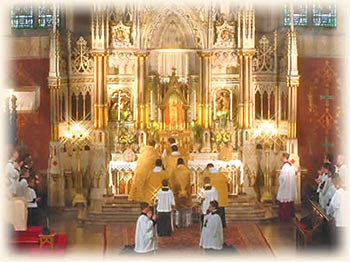 |
| Too "ornate" for God? |
But to
me, the most egregious thing in his whole presentation (and this homily was
given as a slide show, apparently), was this statement:
Only the priest and bishop had
thumbs and forefingers consecrated so they could touch the host. To me the idea that only consecrated fingers
could touch the Blessed Sacrament was a bit silly. Why is any finger more
sacred than any other?
Apparently
this deacon does not understand priestly ordination. He doesn’t understand that
the priest’s hands are anointed.

Deacon
Ashmore concludes:
Fifty years since the beginning of Vatican II, I think the reforms instituted have made our church into a much better place. The people of God are the worshiping community, not a community separated from the clergy. While we praise and worship our mystical God, we are more in touch with the immanent God who sits with us in our own skin. There is still much work to be done. There are still too many ignored and silenced voices. But let us rejoice during this anniversary in the strides that we have made, and ask our good and gracious God to be with us as we strive to chase the money changers out of the temple and become the people and church that he wants us to be.
“Much better place”?! Then why is attendance at Mass so dismal?
“Separated
from the clergy”?! You betcha! That’s why we ORDAIN priests. Duh.
“Too
many ignored and silenced voices”?! I couldn’t agree more! Mine is one of them
- along with everyone else who would like to have a regular celebration of the
extraordinary form of the Mass, and who would like to see a “reform of the
reform” – or even those who just want a faithful following of the rubrics for a
novus ordo Mass.
“Become
the church God wants us to be”?! YES! We had some explicit instructions about
that, and liturgical worship. Still do. But people like Deacon are either
unaware of the rubrics – even of their precious Novus Ordo! – or simply wish to
impose their own interpretation.
Well,
go and read the homily for yourself if you want to see a picture of what seems
to be a willful misunderstanding of the extraordinary form of the Mass. You can
read about the dark, scary confessional, and the exclusion of girls from altar
service, and how “terrified” the young people were at confirmation (and they
were SEGREGATED, too!).
I am
running out of patience with people who spout this kind of nonsense. Especially
clerics who do so.
Ugh.
For the other side of the coin, see yesterday's post "The Vortex: Latin Anyone?"
Also related:
Ugh.
For the other side of the coin, see yesterday's post "The Vortex: Latin Anyone?"
Also related:
