 Remember the big brouhaha over Nancy Pelosi’s (and others’)
statement that “98% of Catholic women use contraception”? There have been all
sorts of articles and comments about why that figure is wrong. Frankly, I don’t
think it matters whether or not the figure is 98%. Whatever the true percentage,
it’s still high, and it’s about the same for women whether they are Catholic or
Protestant. The point is, there are a whole lot of Catholic women using
artificial contraception.
Because of the media interest in the issues raised by the
HHS contraception mandate, there have appeared a few news articles on NFP, both
in the secular press and in the Catholic blogosphere. We’ve heard about how NFP
is “not
Catholic contraception”, how NFP is licit, how NFP is just as effective as the Pill,
and so on. On this blog, I’ve been examining the fact that NFP is licit only
for “serious reasons”, and questioning the wisdom of promoting NFP without
fully investigating how we should define those “serious reasons”.
Now, the same study that was used to promote the notion that
98% of Catholic women have used contraception also notes that only 2% use NFP
(see an article about this here).
No one has contradicted that figure,
and I have not been able to find any other study of the frequency of use of NFP
in the US, whether for Catholics, non-Catholics, or the general population. I’m
inclined to believe the 2-3% figure is reality.
This has made me realize that the problem isn't really
NFP, per se.
That is, the 2% of Catholic couples using NFP – many of whom
seem to have at least “medium-sized” families – are not the cause of the
decline in the size of Catholic families over the last half-century or so. There
aren’t enough of them to have that kind of effect.
 |
| But...why not? |
Let’s face it: even if NFP can be as effect as the Pill,
the fact is, it's not...due to God's
design and human concupiscence, which combine to make NFP "difficult"
to practice. And you have to admit that most people are not into
"difficult" these days, which will probably prevent NFP from ever
spreading like wildfire.
(Oh yeah…and there’s the fact that NFP is only supposed to
be used for “serious reasons” – it’s a pesky little detail that cannot be
relegated to the realm of the couple’s “discernment”.)
There is a
contraceptive mentality behind NFP, and that is a problem. That contraceptive
mentality is there despite all the protestations to the contrary.
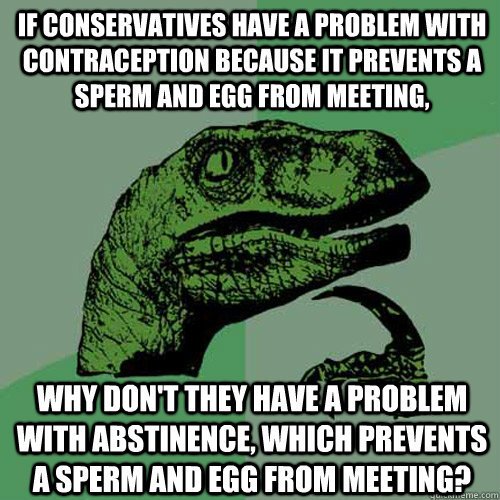 |
| The secular world seems to get the connection... |
(Of course, the funny thing about children is that once you
have them, it’s hard to imagine life without them. A friend of mine was trying
to keep tabs on her five children after Mass one Sunday, and someone snidely suggested
that maybe she shouldn’t have had so many. The harried mother’s response was, “And
which one do you think I shouldn’t have had?”)
I am not arguing that NFP is equivalent to artificial
contraception such as the Pill or IUDs; I don’t think that’s the case. I am
saying that the motivation for the
use of either is the same: the desire for personal control over the number of
children and the timing of their appearance (I'm not addressing here the use of NFP to achieve pregnancy). I don’t deny that NFP couples are
more open to life than those who have opted for artificial contraception, but I’ve
been surprised by the extreme defensiveness I’ve seen on recent blog posts, especially
in the accompanying comments. You’d think that the mere suggestion that couples
should trust God’s timing was a sin!
I think H. Crocker III had a near-perfect grasp of the issues
when he wrote an irreverent, flippant, and very humorous article about NFP a few
years ago. He was reminding his readers that the primary end of marriage is
procreation; among the more serious comments he included are these (emphases mine):
The
case for NFP should, by rights, be the
case for more babies. To have them is good. Not to have them is to be
deprived…
…another
reason for NFP's allegedly high success rate is that couples who use it are prepared to welcome children and so don't blame NFP for unexpected
pregnancies. Four of my own five children came the NFP way – that is, totally
unexpectedly – and that's a good thing, because without them bouncing in as
surprises, excuses to delay (the
sort of excuses one might hear from a recruit in parachute training) might have gone on for a very long time…
 Rather
than bite one's nails to the quick at the prospect of baby number ten – which, if one marries in one's early 20s and
practices NFP, is a definite possibility – we
should encourage the attitude of the more the merrier, which is a far more
attractive case to make than all the goo-goo language about how NFP helps
couples "communicate" and about the joy of charting temperatures and
discharges and plotting one's conjugal acts as a captain might chart a course
for his ship.
Yep. We need more babies.
If you’re hung up on the myth of overpopulation, go to this website and watch their
short, informative videos on the subject. And consider the lesson of the
Japanese, who seem to be on the
road to extinction.
Among Crocker's more humorous
comments was this solution to the problem of priestly vocations:
So rather than focusing on NFP, premarital
preparation should go like this:
Father
O'Counselor: "Now I want you two to understand that the primary and fundamental
purpose of marriage is not companionship, not romantic love, not moonlit
strolls on the beach, or any other balderdash but the begetting and raising of
children – lots of 'em, and starting soon. The optimum number is enough so that
you can lose a few at the grocery store and not notice. That's giving without
counting the cost, and at that point, you won't care anyway. As a priest, my
sacrifice for the good of the Church is celibacy. As a married couple, yours is
to propagate children – who will incidentally annually propagate fierce storms
of influenza in your house. If you haven't already studied up on communicable
diseases and basic first aid for children jumping off sofas, I'd do it now. But
you will find children and their challenges to be the great tutor of not only
the medical but the moral virtues."
 Potential
Husband: "You mean, I'm screwed?"
Father
O'Counselor: "In a manner of speaking, yes."
Potential
Husband: "Is it too late to enroll in the seminary?"
We
can thus improve Catholic marriages and alleviate the priest shortage at the
same time.
So… go and read H. Crocker
III’s whole article here. If it
makes you laugh…you’re on solid ground, I think.
If it makes you angry…well…I
think that reflects a contraceptive mentality in search of a defense.
Related:
Marital Chastity, Fruitful Multiplication...and NFP?
And see this wonderful post by Cam at A Woman's Place...
