What’s missing in most discussions of NFP, and birth control
in general, is a discussion of the purpose of marriage – largely because of the
“personalist” (phenomenalistic) philosophy of most NFP proponents.

The “idealist” version of personalism, an NFP staple, seems
to be deliberately myopic, taking human experiences as "data" for the
philosophical experience, without any necessary context. So, while acquiescing
to the obvious – that sex is and can only be for procreation –NFP personalists
nevertheless focus on the human reality of "sexual experience" as a
thing in itself. This is like observing the role of eating for nutrition, and
then deciding to focus on the mystical and "human dimensions" of
eating itself.
The conclusion of personalism appears to be that, since we
are human beings, everything we do
should be done in a distinctly human way. Therefore, we should eat, and pee,
and copulate in some mystically human
sense. That eating, and peeing, and copulating have always been understood in
terms of "purpose" is ignored so that we can contemplate our navels
in ecstasy.
 Now, the primary purpose of marriage is procreation. Therefore,
if “purposely sterile sex" (however that is achieved, whether artificially
or naturally) is judged to be a good thing in and of itself, then marriage doesn't
even have a point any more beyond the civil and contractual. The classic
definition of marriage as a contract "for the mutual and exclusive rights
to acts appropriate for the procreation of children" makes no sense when
"purposely sterile sex" is entertained as some kind of equivalent
end. "Purposely sterile sex" just guts the original intention for
marriage.
Now, the primary purpose of marriage is procreation. Therefore,
if “purposely sterile sex" (however that is achieved, whether artificially
or naturally) is judged to be a good thing in and of itself, then marriage doesn't
even have a point any more beyond the civil and contractual. The classic
definition of marriage as a contract "for the mutual and exclusive rights
to acts appropriate for the procreation of children" makes no sense when
"purposely sterile sex" is entertained as some kind of equivalent
end. "Purposely sterile sex" just guts the original intention for
marriage.
Personalists
focus on the existential reality that man and woman are together and express
their love for one another in a particular way, ignoring that there is a purpose for expressing their love in
that particular way. Oh yes, they acknowledge
the procreative end, but reduce it to something that must be brought under the
control of the human will, which is alleged to have become “enlightened” in recent
times to allow for “prudent and responsible parenthood”. (And I think one of
the most unfortunate additions to the language of recent Church documents is
that phrase, “responsible parenthood”.) Sex becomes something to be enjoyed in and of itself, both for the physical
ecstasy and the mystically unitive end it is said to serve.
In marriage, we serve God's purpose by procreating with Him. If that isn't mystical enough, what is? In expressing our love for one another in a way particular to marriage, we procreate with God new citizens for Heaven and (Deo Gratias!) we grow in the marital love so necessary to be good parents to those procreated beings! It bothers me a lot to think of focusing on the physical act of love between married persons in some way that gives it significance beyond its primary purpose. Clearly the “unitive” and “self-gifting” ends touted by the “personalist” view are secondary ends of marriage, and should only be appreciated in light of the primary purpose of the marital act.
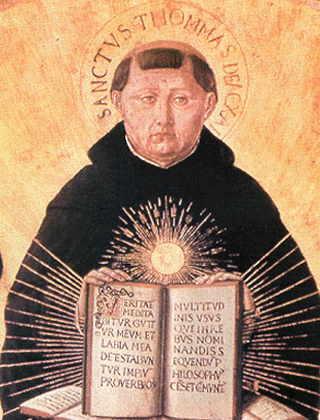 Realists,
like St. Thomas Aquinas, see an ordered world that can be experienced directly
and understood through its purpose. Aquinas does see "secondary
effects" and even "secondary motivations" that drive human
beings to mate, but he understands all
of it through its primary purpose. Absent a purpose, actions have no context
for evaluation, and we end up with that maddening expression, “it is what it is”.
Only GOD "is what it is".
The rest of reality is “for something."
Realists,
like St. Thomas Aquinas, see an ordered world that can be experienced directly
and understood through its purpose. Aquinas does see "secondary
effects" and even "secondary motivations" that drive human
beings to mate, but he understands all
of it through its primary purpose. Absent a purpose, actions have no context
for evaluation, and we end up with that maddening expression, “it is what it is”.
Only GOD "is what it is".
The rest of reality is “for something."
There
is not going to be marriage in Heaven, and hence, no "marital
embrace", because there is no
purpose to marriage or the
"marital embrace" in Heaven. There is a purpose to marriage here on earth: procreation. The means to
that end involves the marital act.
But, because
of Original Sin, the sexual appetite that prompts the marital act, which has procreation
as its purpose, is disordered. And on some level, JPII’s “Theology of the Body” as it is
interpreted by writers like Christopher West (and let’s face it: more people
are listening to West than are reading the original tome of TOB) is little more
than a pandering to concupiscence, a rationalization of sexual fantasy, and an
exaltation of the couple’s “responsibility” to “determine” how many children
they will have.
The true evidence of the exchange of marital love is a conceived child! Fr. William Gardner notes that the sexual act is directed by nature to procreation, though it does have benefits that accrue even if procreation is not achieved in a particular act.
The true evidence of the exchange of marital love is a conceived child! Fr. William Gardner notes that the sexual act is directed by nature to procreation, though it does have benefits that accrue even if procreation is not achieved in a particular act.
…[T]he sexual act can only
reach full perfection in conception. A non-fruitful act of sexual
intercourse may be morally licit and mutually beneficial to the spouses and may
also consummate a marital commitment (in each case, reaching a real level of
perfection), but it is not a fully perfected sexual act since human life has
not been transmitted. The sexual act has not achieved the end that
distinguishes it from all other kinds of human acts. (From “A Theology of
Life-Giving”, Homiletic and Pastoral Review, August/September 2007)
Fr.
Gardner also quotes Blessed John Paul II: “…fecundity is the living testimony
of the full reciprocal giving of the spouses” (Familiaris Consortio, #28).
 In
other words, this "total donation of self" is the child, whose birth
and subsequent raising and education provide the vehicle for growth in all the
virtues characterized as "unselfish." Two "selfish" people
"make love", and their child is the fruit of that love.
In
other words, this "total donation of self" is the child, whose birth
and subsequent raising and education provide the vehicle for growth in all the
virtues characterized as "unselfish." Two "selfish" people
"make love", and their child is the fruit of that love.
When
procreation is intentionally left out
of the equation – whether by artificial methods, or "gaming" the
system with "natural methods" – there is no exchange of love, no
donation, and you are left with "mutual masturbation”. This can never be "self-giving" or
"self-donating." Such "love-making" is inherently selfish
because there is an intention against the fruitfulness which is the sign of
married love.
Many couples
using NFP have made themselves co-equal partners with God in deciding when and
whether they should have children, based on their supposed duty for “responsible
parenthood” and “prudence”. They are forgetting the scripture verse that says "you
are worth more than many sparrows", which is intended to teach us that God
will provide for what He loves; and He loves to be a partner in procreation, so
He will provide for those who trust
Him. When we are "responsible" by deciding that God wouldn't want us
to have more children than we can provide for, we act as if
that is all up to us! Worldly “prudence” is antithetical to abandonment
to Divine Providence.
I’ve
been accused of reducing women to wombs, but some NFP proponents seem to reduce
women to vaginas in need of regular stimulation. I’m trying to discuss "the
duty of motherhood" and all that implies; some NFP proponents seem to have
lost the sense that the "duty of motherhood" is another word for “marriage"
and, in fact, defines its purpose. What more noble task can there be than to
partner with God to raise up saints?!
There are those who will continue to stubbornly defend their “right” to purposefully avoid pregnancy in the interest of “responsible parenthood” – even when evidence of the constant teaching of the Church is staring them in the face. They will one dav stand before God and have to answer for the children they didn't have and for all the sex that they thought was more important.
There are those who will continue to stubbornly defend their “right” to purposefully avoid pregnancy in the interest of “responsible parenthood” – even when evidence of the constant teaching of the Church is staring them in the face. They will one dav stand before God and have to answer for the children they didn't have and for all the sex that they thought was more important.
 |
| St. Pelagia, a repentant sinner...one of my own personal patron saints. |
But
there are plenty of others of us out there who are now past the point of
childbearing, but have come before God and said "I didn't know and I am so sorry – forgive me!" Like
grieving for an abortion, we can't undo our past failures with regard to birth
control, but we can say "I'm
sorry. Forgive me", and do penance. And we can accept that as part of God's plan for us, because God created us to be
filled and fulfilled by Himself.
And
there are those who are in between – those of childbearing age who are using or
thinking of using NFP (or contraception) to limit the size of their families. If
you are one of those, and if you’ve read this whole post (congrats on your high
level of perseverance!), and you are questioning your own reasons for avoiding
pregnancy, I encourage you to ponder the truths the Church has always taught, rather than be swayed solely
by current, “modern” thinking on this issue. It’s important…for your own soul,
and for the souls of the children God perhaps wants to give you.
Click on the NFP tab at the top of the page for a list of other NFP posts on this blog.
Click on the NFP tab at the top of the page for a list of other NFP posts on this blog.
